Styles /
contemporary-kitchen
Contemporary Kitchen In London – Bold Design, Flawlessly Executed
Contemporary is where design gets to lead. Statement islands, expressive materials, open-plan spaces.
Layout & Workflow
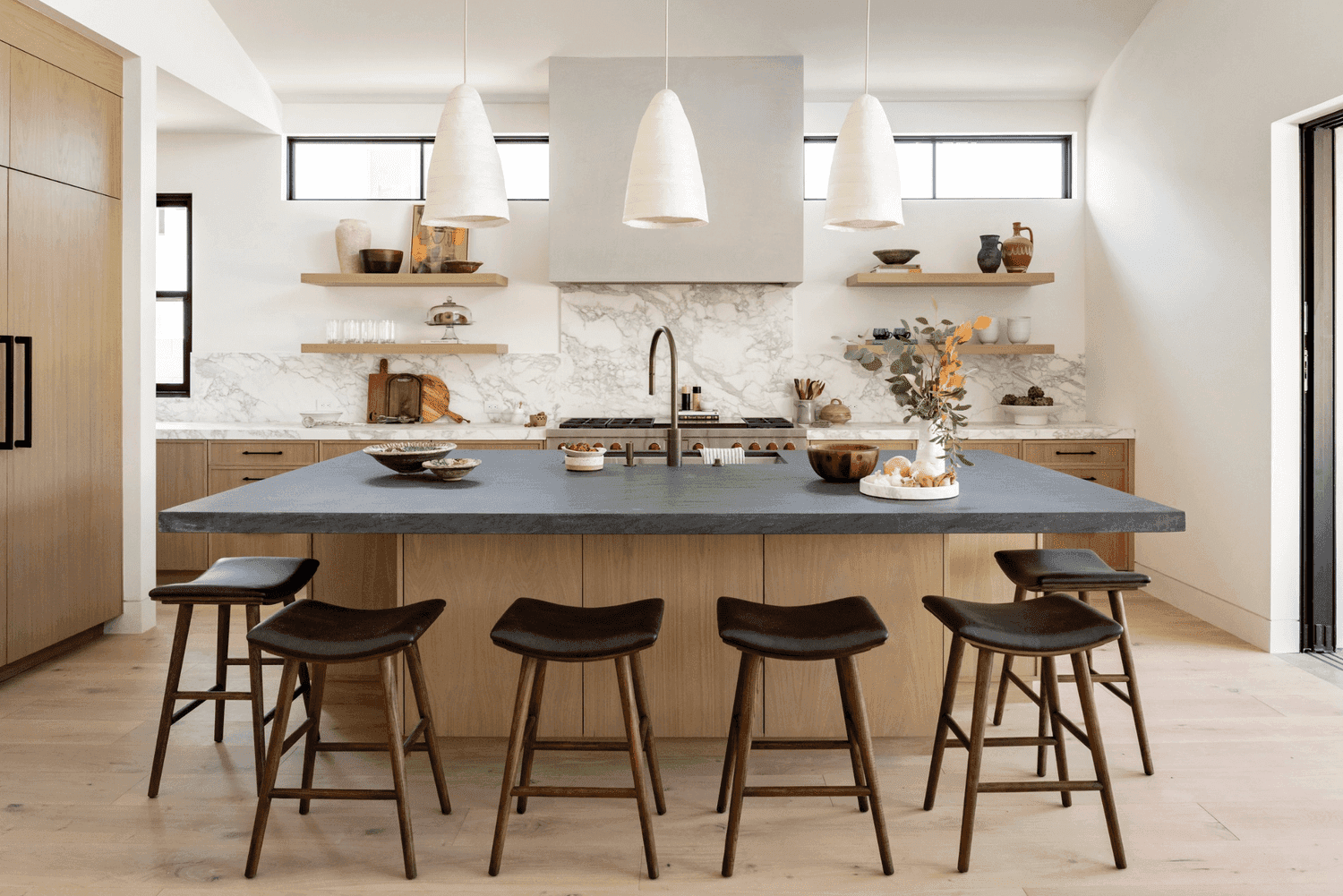
A contemporary kitchen in London is built around choreography – clear zones, generous circulation, and a social plan that assumes more than one pair of hands.
The classic work triangle still underpins it, but contemporary planning expands it into active zones (prep, cooking, clean-up) tightly organised around the main run and island, and passive zones (coffee, breakfast, seating) at the edges so guests can hover without cutting across the cook's path.
London Layouts We Work With:
Island in a side-return extension. Centred under rooflights, activity pulled into the middle, clear lane to the garden.
Peninsula in a mansion flat. Extra prep and seating while zoning the kitchen from the living space without blocking sightlines.
Slim peninsula in a compact new-build. Tight U or L with integrated storage, modest footprint feeling generous.
Sink or hob on the island. Cook faces into the room, not the wall; sightline from front door through kitchen to glazing or garden.
Cabinetry
Contemporary cabinetry is where classic ideas and current tastes meet – clean but not clinical, tailored but not minimal for minimalism's sake.
It sits between traditional and modern. Shaker rails, framed doors, and warm woods appear – but with slimmer profiles, simpler mouldings, and bolder colour or material contrasts. The backbone is modern Shaker: thinner frames, crisp inner edges, and shallow panels that read lighter and less country. Mixed across a single kitchen:
Slim Shaker on main runs – familiar, architectural, period-friendly
Slab fronts on islands or tall appliance banks – graphic weight where it counts
V-groove or framed glass doors – rhythm and texture without visual noise
Finishes Are Surface-Led:
Painted warm neutrals, deep greens, blues, and charcoals alongside rift-cut oak, walnut, or ash veneer. Two-tone schemes – timber or darker bases with lighter uppers, wood-clad island against painted perimeters – give depth without clutter.
Hardware Nudges The Look Contemporary:
Slim bars, linear pulls, or refined knobs in brass, black, or stainless – sometimes mixed across door styles to reinforce the updated-classic feel.
Worktops
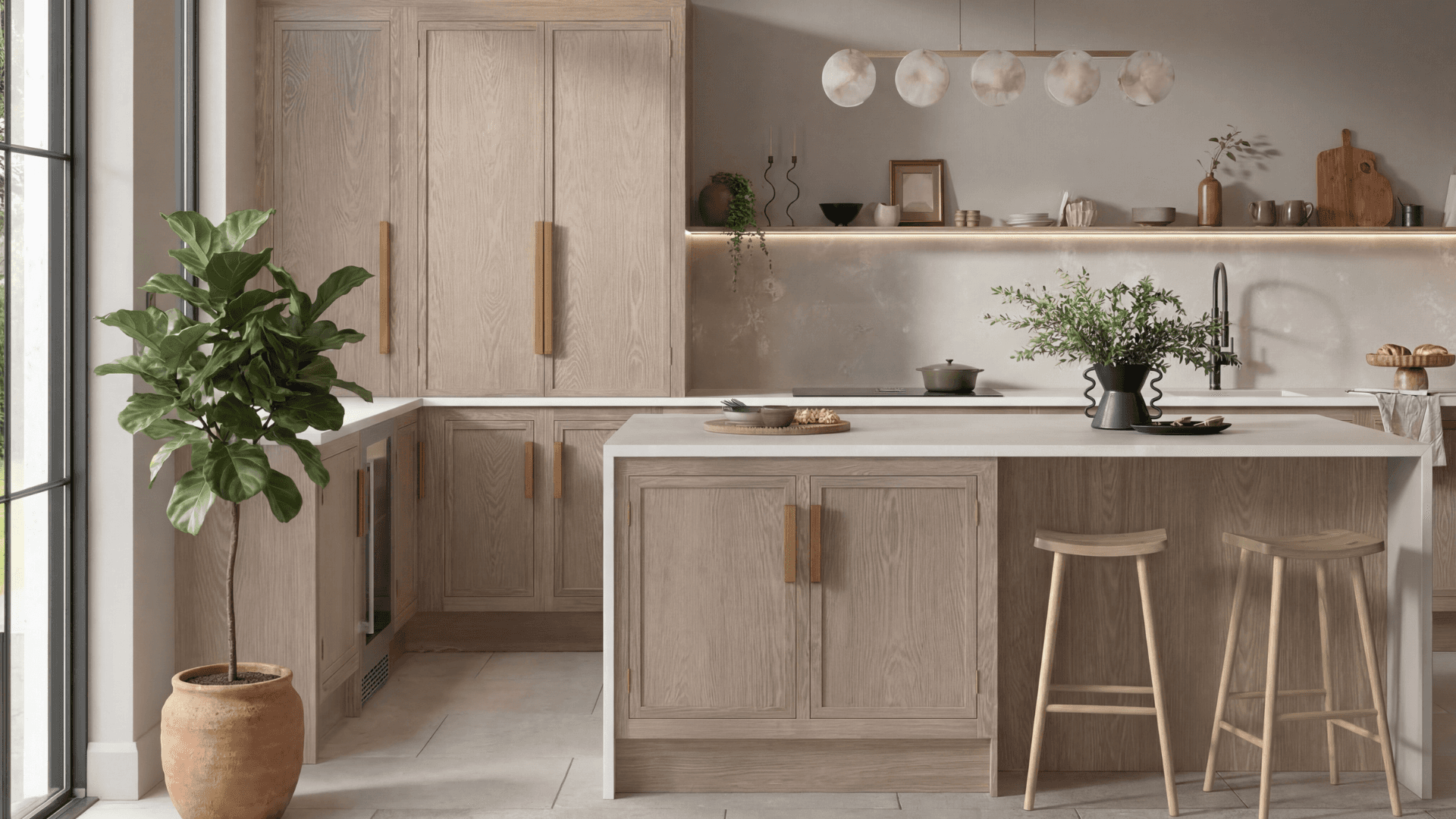
In a contemporary kitchen, worktops are where you can be a little braver – mixing natural and engineered materials, quiet runs and statement slabs, without losing practicality.
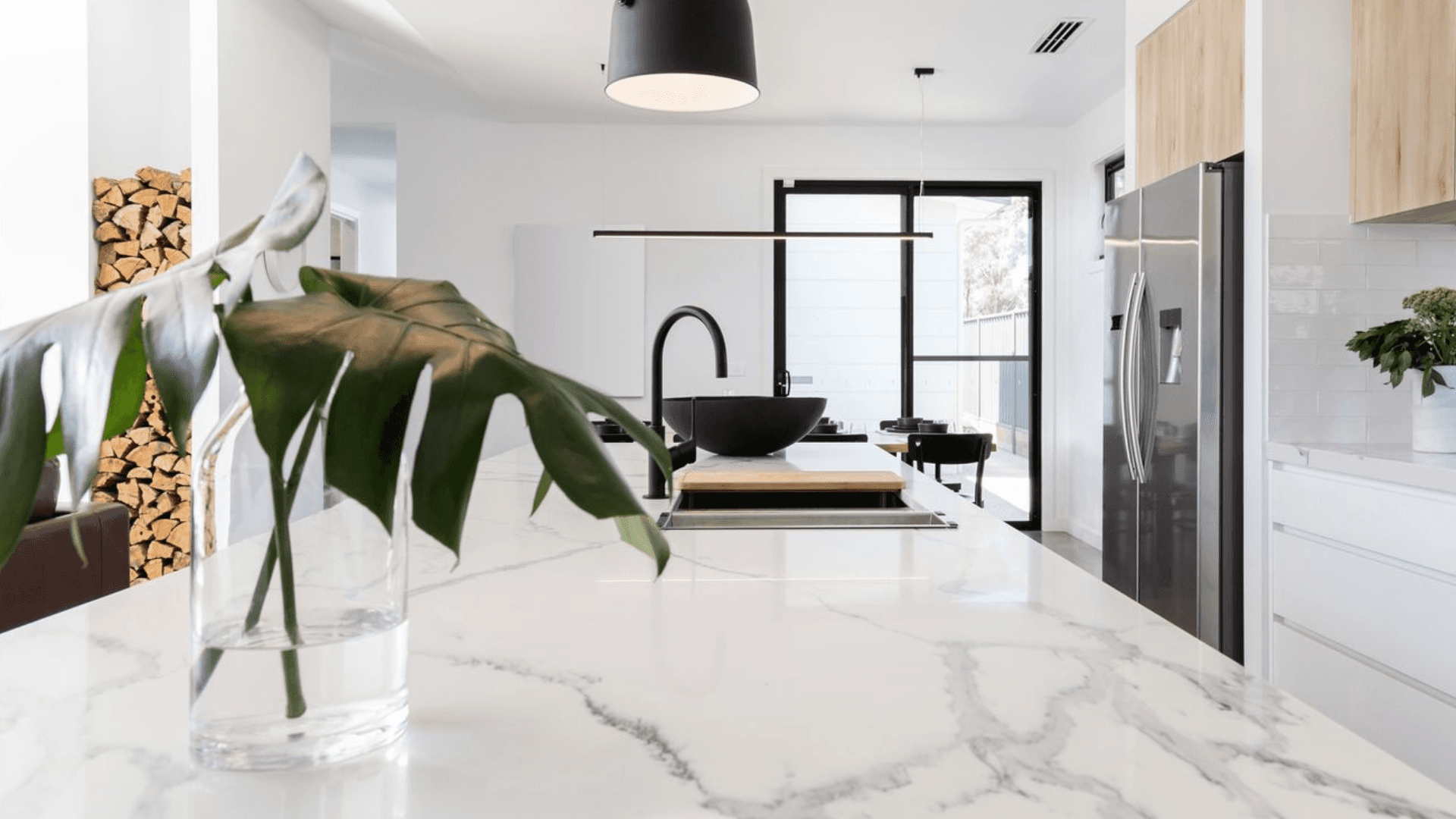
Quartz, porcelain, and Dekton dominate the main runs: durable, low-maintenance, and available across marble-look, concrete, and solid tones that suit open-plan rooms.
Timber (usually oak or walnut) still appears on islands or breakfast bars to soften painted or slab cabinetry, but as an accent rather than wall-to-wall.
Where Drama Belongs:
Main runs – calm, mid-thickness stone or quartz in gentle veined or concrete finishes; cabinetry and tiling do some of the talking
Islands and peninsulas – bolder veining, deeper colours, or a contrast material; one clear focal point rather than pattern everywhere
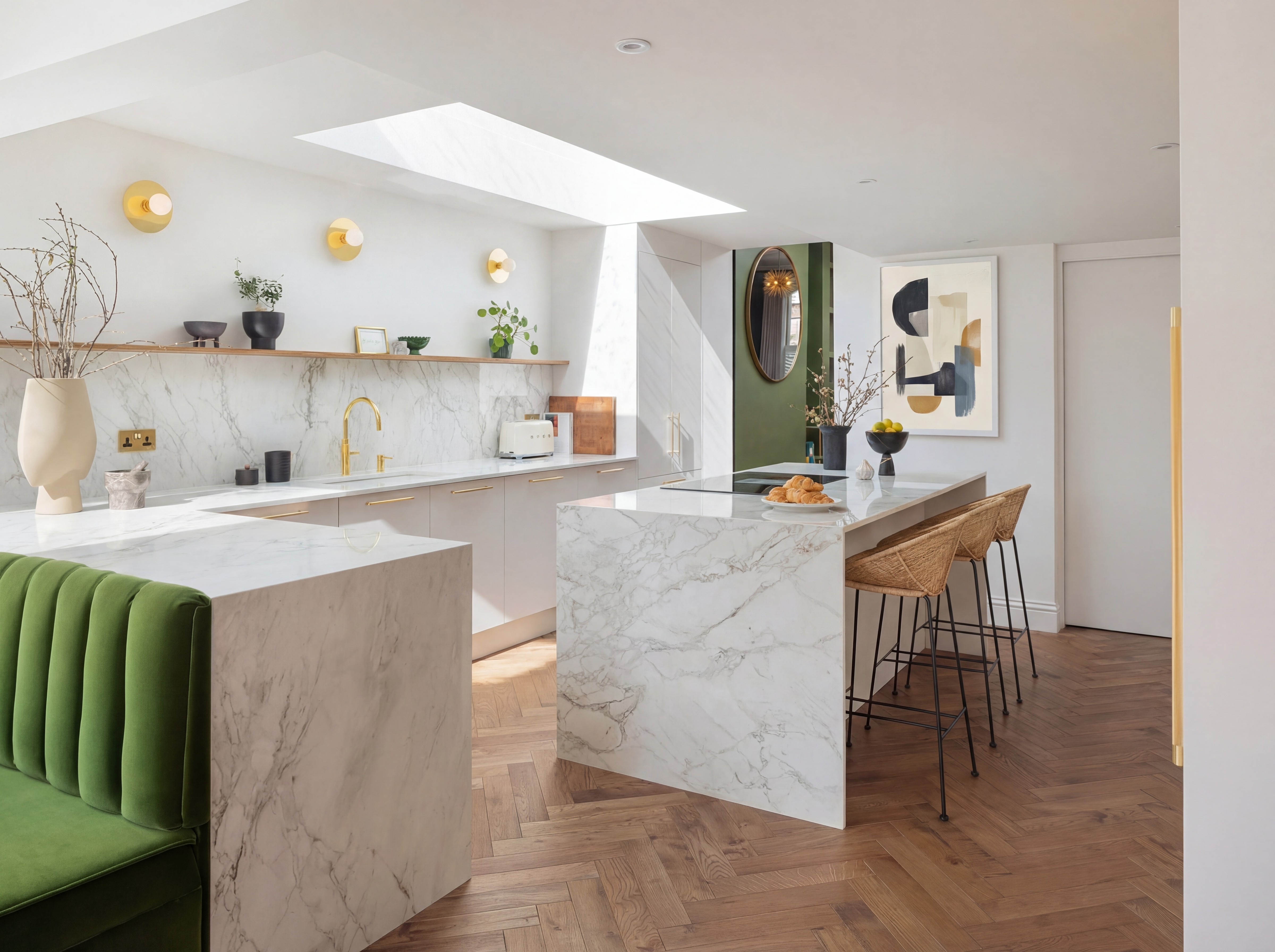
Waterfall edges – slab drops to the floor for a sculptural, more modern statement
Thick mitred "framed" edges – mass kept on the horizontal plane, quieter but still luxurious, especially with Shaker cabinetry
Bold Veined Stones Need Balance:
Simpler cabinetry, quieter splashbacks, considered seam, and vein direction so the worktop reads as a single deliberate feature rather than visual noise.
Hardware & Metals
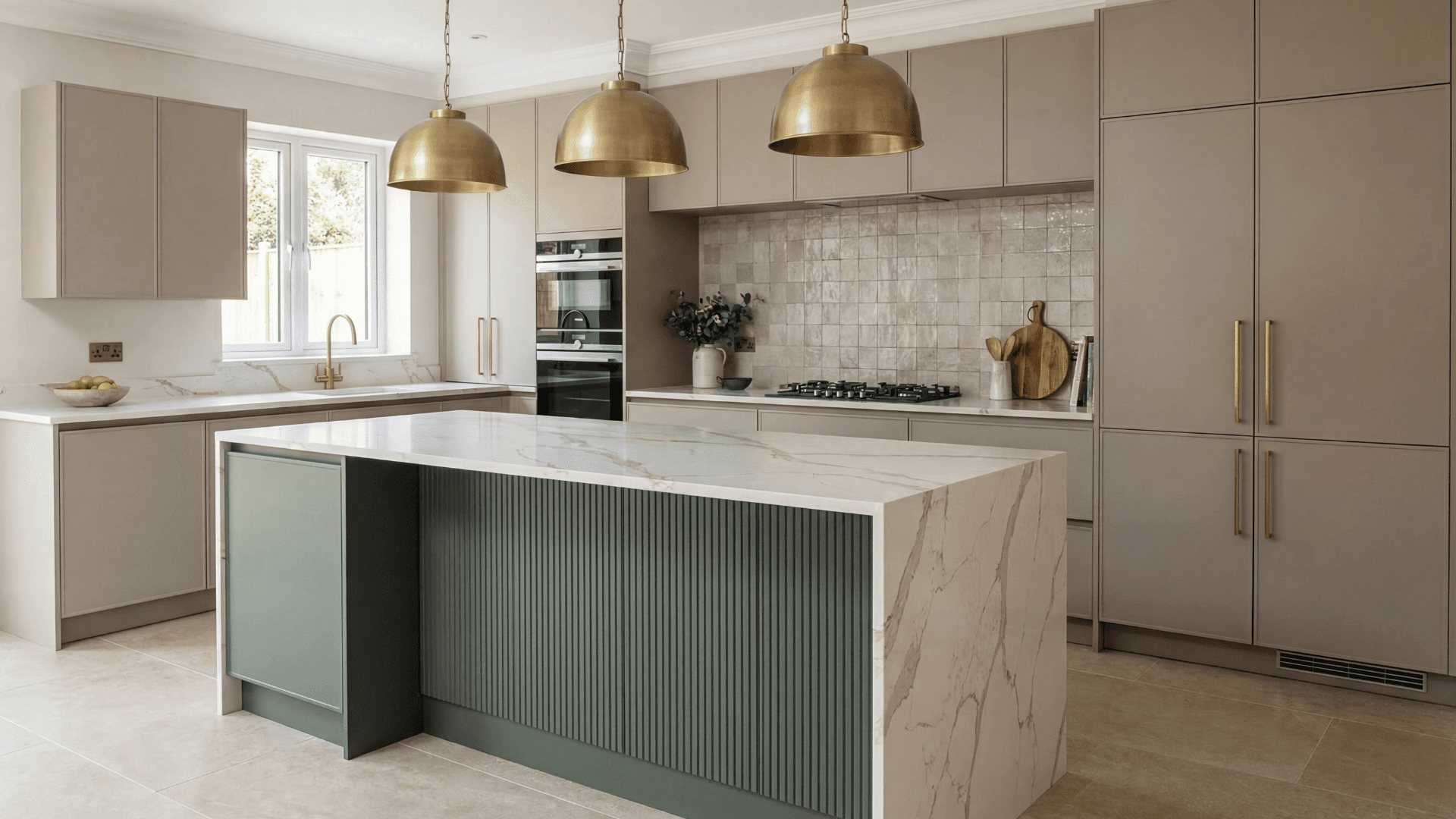
Contemporary hardware is slim, tailored, and warm enough to stop clean lines from feeling cold. Slim bar pulls, streamlined D-handles, and refined knobs sit across doors and drawers rather than chunky heritage cups or fully handleless fronts. Handles are longer on wide drawers and tall doors, emphasising cabinetry proportions and giving a more bespoke, furniture-like feel.
The Contemporary Metal Palette:
Brushed brass, champagne, and soft gold – warmth and depth without the glare of polished finishes; the dominant contemporary choice
Matte or satin black – supporting player, framing glass, grounding pale cabinetry, edging shelves
Stainless on taps and appliances – practical, neutral, keeps things familiar
Mix Intentionally:
Two dominant finishes, one accent, each repeated at least three times around the room – brass handle echoed in pendants, and a shelf bracket, black on the tap, echoed in window frames. Contemporary hardware is about editing rather than decorating: just enough glint and contrast to bring the joinery to life without fighting the architecture.
Tiling & Splashback
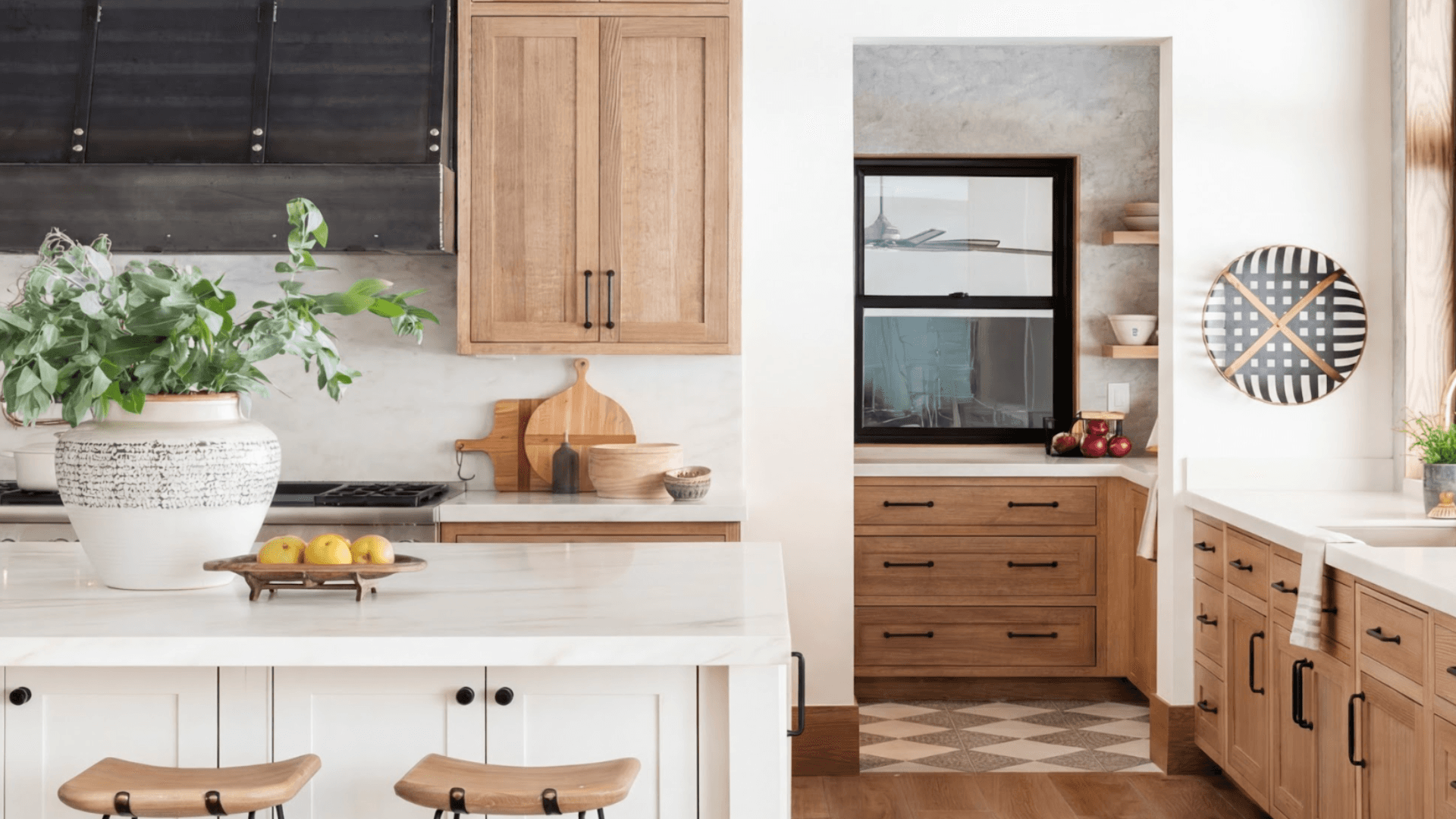
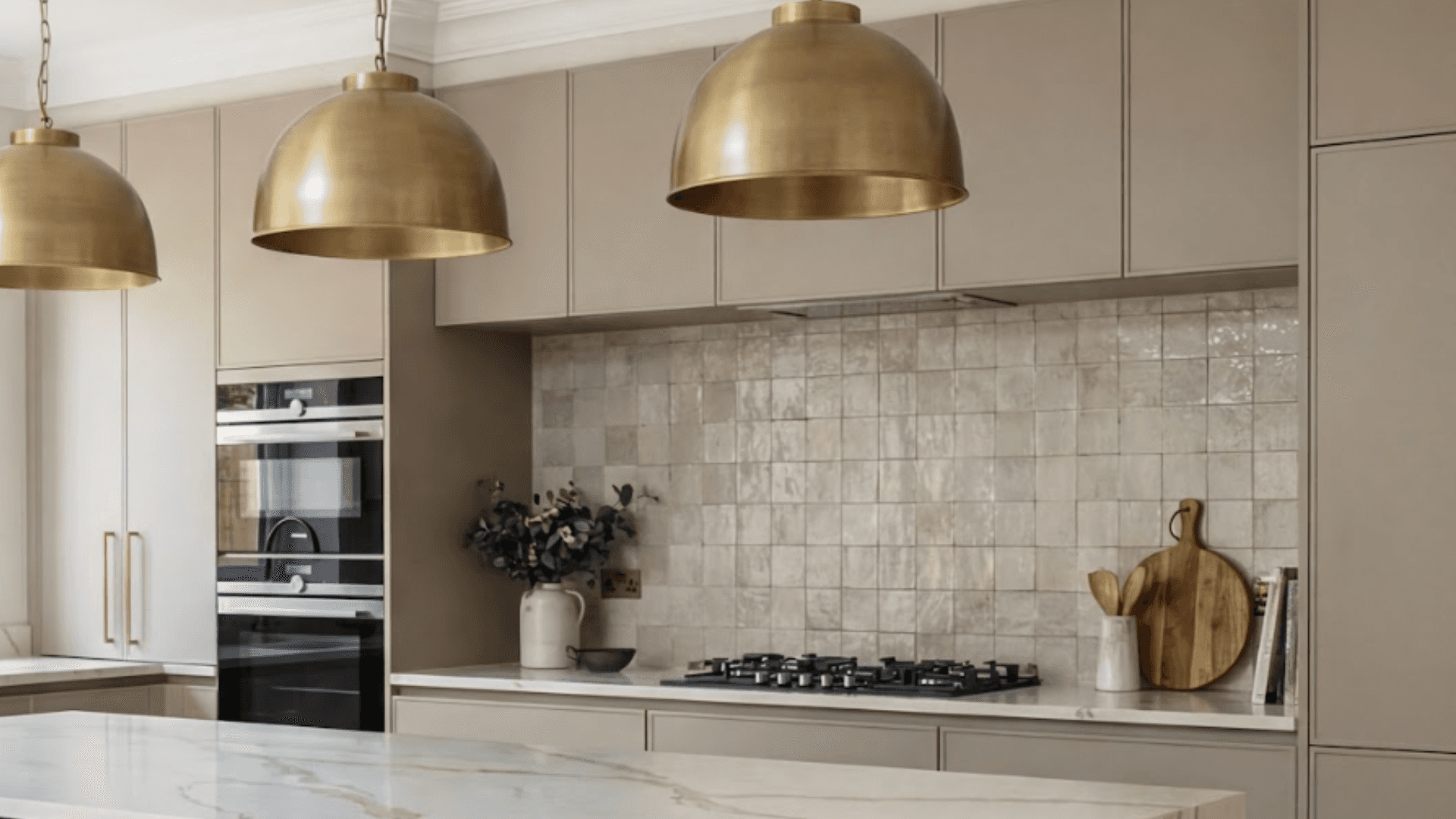
In a contemporary kitchen, the splashback bridges classic and modern – more textured and expressive than a purely timeless scheme, calmer and more curated than a full-on statement wall.
Materials & Where They Work Best:
Zellige and Zellige-look tiles – soft irregularity and light-play that works beautifully with Shaker-meets-modern cabinetry, especially in earth tones, greens, and soft neutrals
Contemporary ceramics in satin or gloss – square or slim rectangular, laid stacked rather than brick-bond, fresh while staying quiet
Slab stone or quartz continued from the worktop – seamless, easy-wipe, very contemporary behind the hob, classic when the stone is subtle
Low-iron or painted glass panels – clean, easy to wipe, pairs well with tiles elsewhere
The Rule:
Let either the worktop or the splashback be the louder element, not both. Bold veined stone pairs best with quieter tiles or matching slab; busier tiles sit more comfortably over calm worktops. Tone-on-tone grout keeps things seamless; a slightly deeper shade outlines tile shapes without screaming grid. In London's open-plan rooms, the splashback is visible from sofas, dining tables, and sometimes the garden – it has to work from every angle.
Flooring
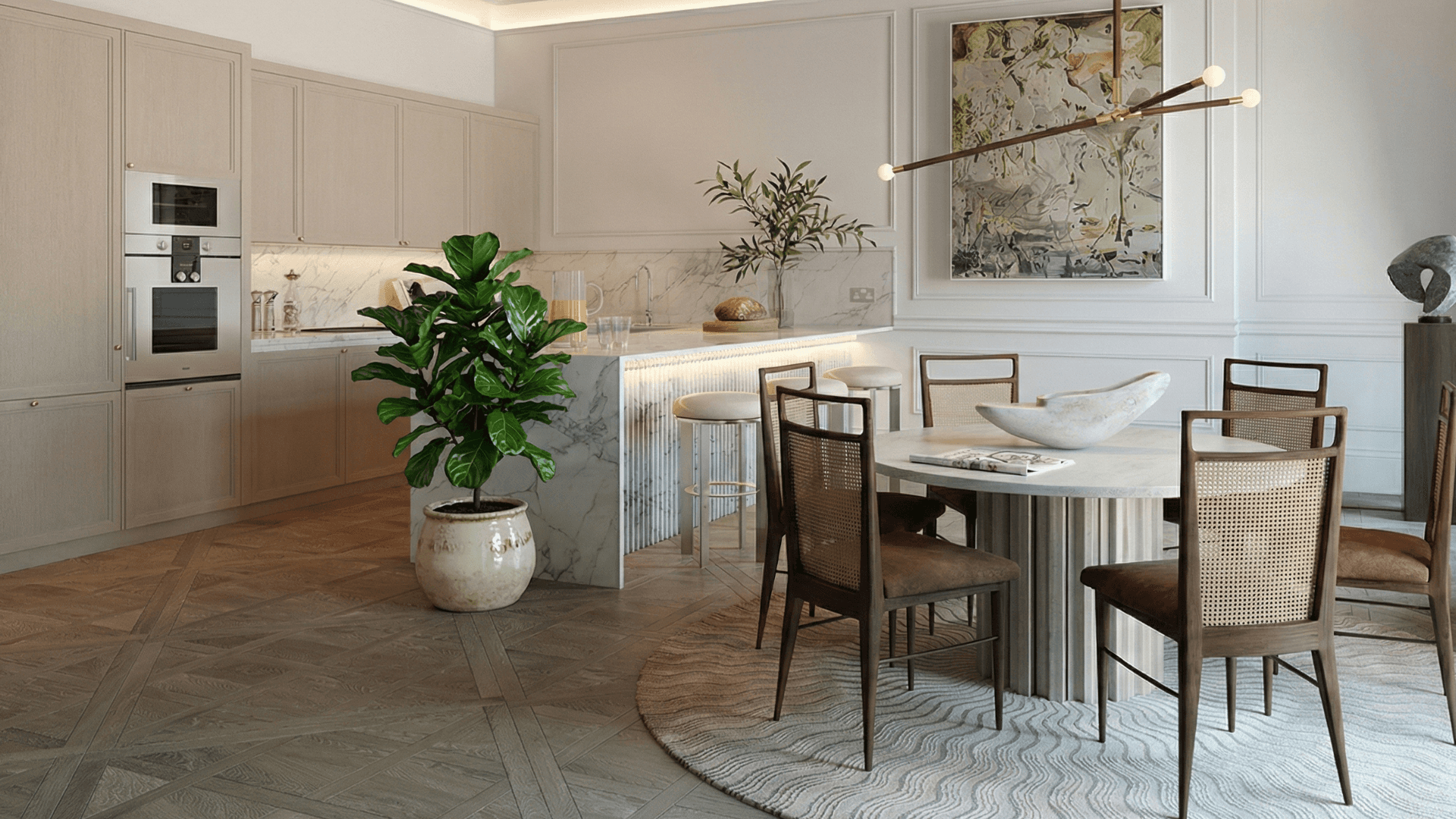
The floor in a contemporary London kitchen is the quiet backdrop that pulls old bones and new joinery together – more considered than builder-basic, softer than gallery-modern.
Contemporary schemes lean on three families: engineered wood, stone or stone-effect porcelain, and quality LVT in convincing wood or stone looks. Wide planks and large-format tiles reduce grout lines, feel more expansive in open-plan spaces, and sit naturally with the longer lines of Shaker and slab cabinetry.
Pattern As A Gentle Design Tool:
Herringbone and chevron in oak or wood-effect porcelain – movement and European refinement that suits London terraces without shouting
Terrazzo and terrazzo-look porcelain – subtle graphic edge under otherwise simple kitchens
Soft checkerboards in toned-down neutrals – interest underfoot while walls and cabinetry stay calmer
The Sweet Spot:
Warm mid-tones – beiges, greiges, smoked oaks, soft stone shades – matte or lightly textured, forgiving underfoot and more architectural alongside contemporary joinery. In London, extending one floor finish from the hall through the kitchen into the living space makes modest footprints feel generous and the kitchen feel like part of a single living environment.
Colour Palette
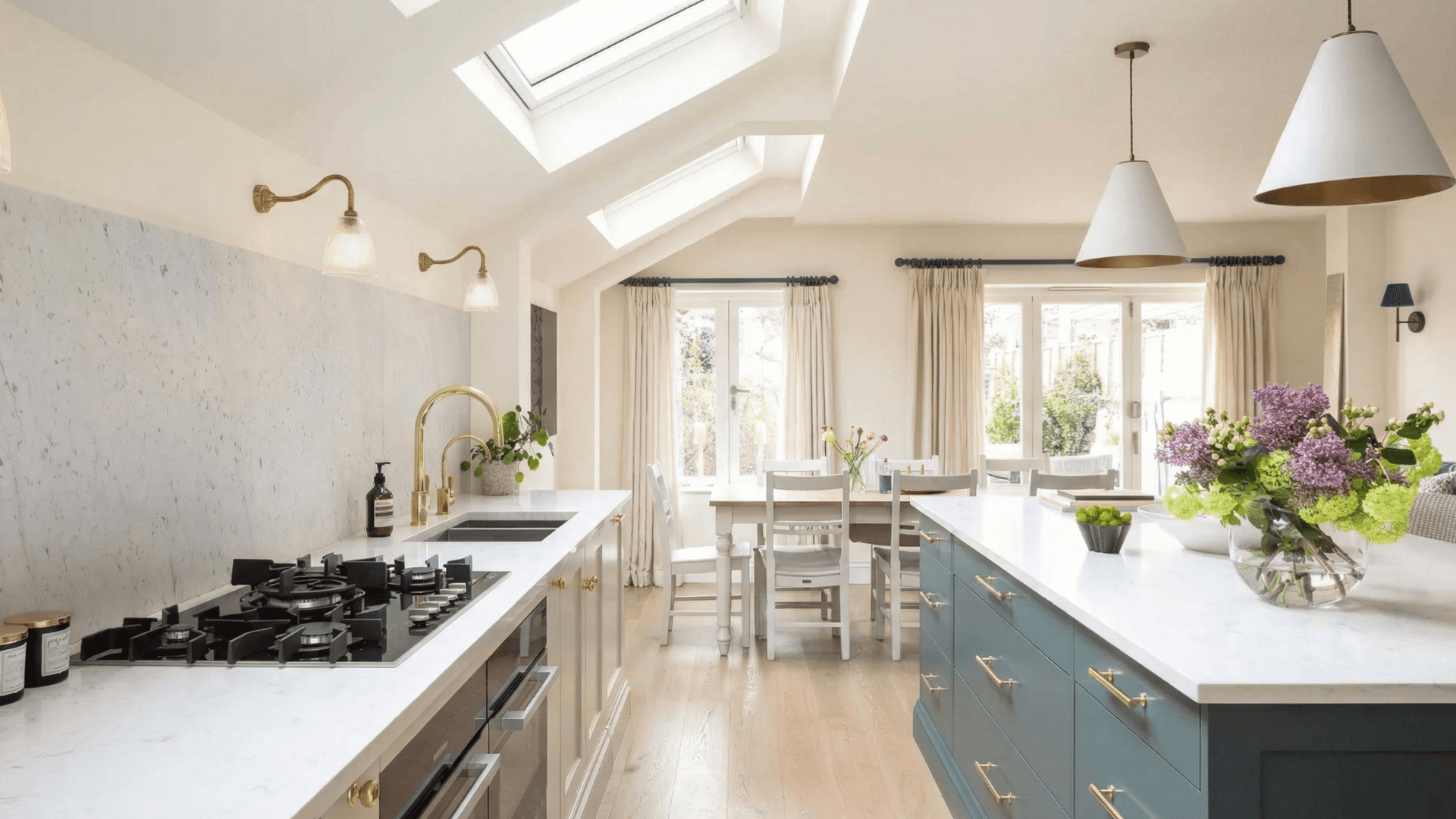
Contemporary kitchen design London lives in the space between classic restraint and genuine personality – warmer and braver than timeless, calmer and more edited than full trend.
The Base Is Always The New Neutrals:
Warm whites, stone, mushroom, taupe, and soft putties drawn from natural materials. These keep spaces bright without glare or flatness, and work especially well in London's open-plan rooms where the kitchen shares air and light with living and dining zones.
From There, Two Directions:
Nature-inspired greens and blues – soft sages, olive greens, dusty blue-greys, and gentle navies as cabinet colours; calming, easy to live with, flattering to timber and warm metals. Colour that carries personality without demanding attention.
Warm earth accents – muted terracottas, plaster pinks, clay and barley tones on islands, walls or internal pantries; a soft glow for north- or east-facing London spaces that need warmth more than brightness.
For Open-Plan Rooms:
Two or three base hues repeated across walls, cabinetry, and adjoining rooms, with smaller accent colours in art and textiles. Deeper or more saturated colour on kitchen cabinetry to ground the space, lighter neutrals on surrounding walls and ceilings to keep the wider room airy. Colour that's confident but calm – rooted in nature, tuned to London light, chosen with the whole floorplan in mind.
Lighting
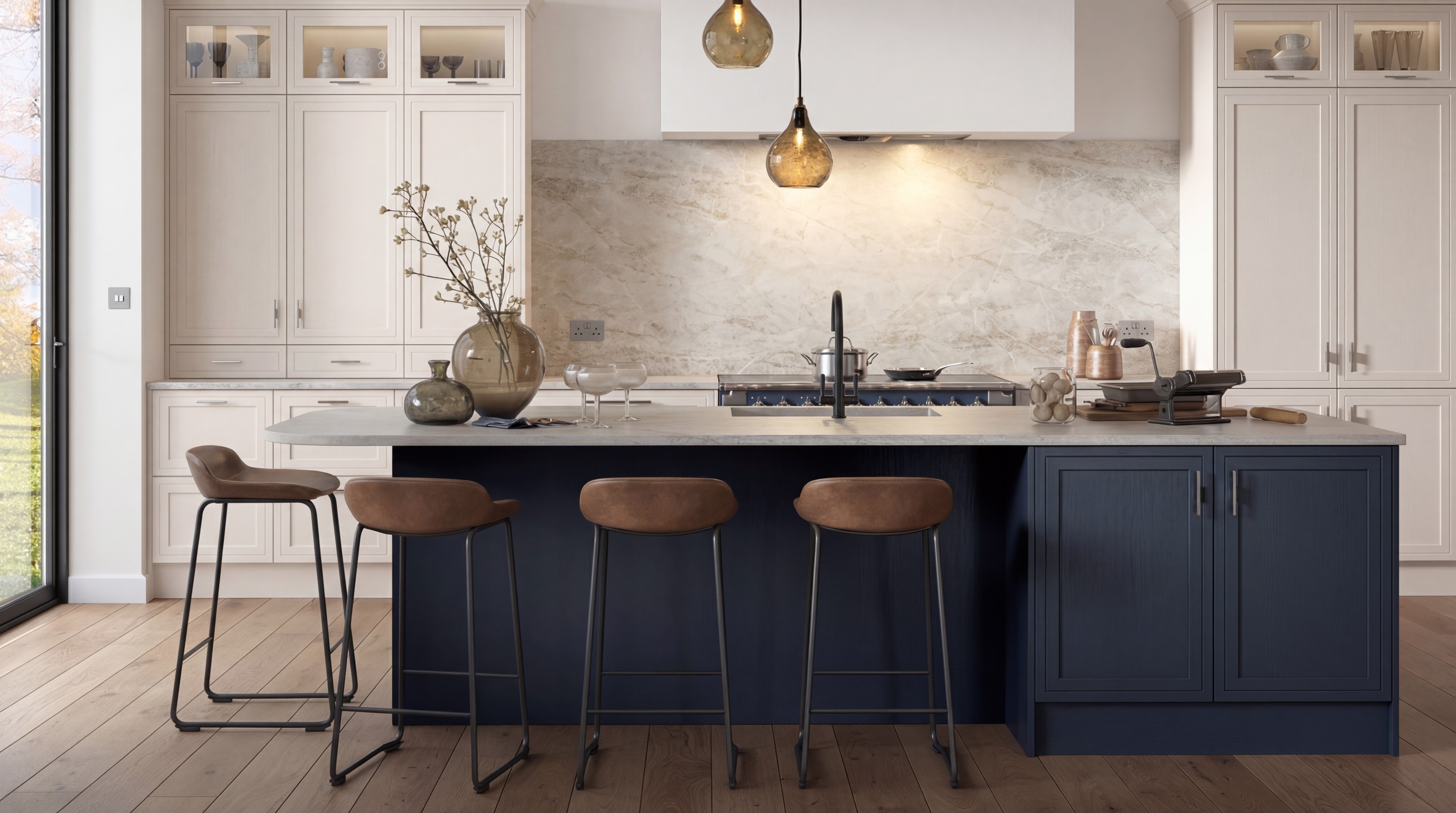
Contemporary London kitchen lighting is architecture-first – layered, dimmable, and mostly hidden, with a few sculptural moments that do the visual work.
Ambient comes from a disciplined grid of recessed spots or slim surface fittings, giving an even base without cluttering the ceiling. Task sits under wall units, over islands, and targeted at the hob and sink. Accent and decorative layers (lit shelves, LED profiles above cabinets, a sculptural pendant or cluster) add depth and let you dial the mood as the kitchen shifts from work to entertaining.
Over Islands:
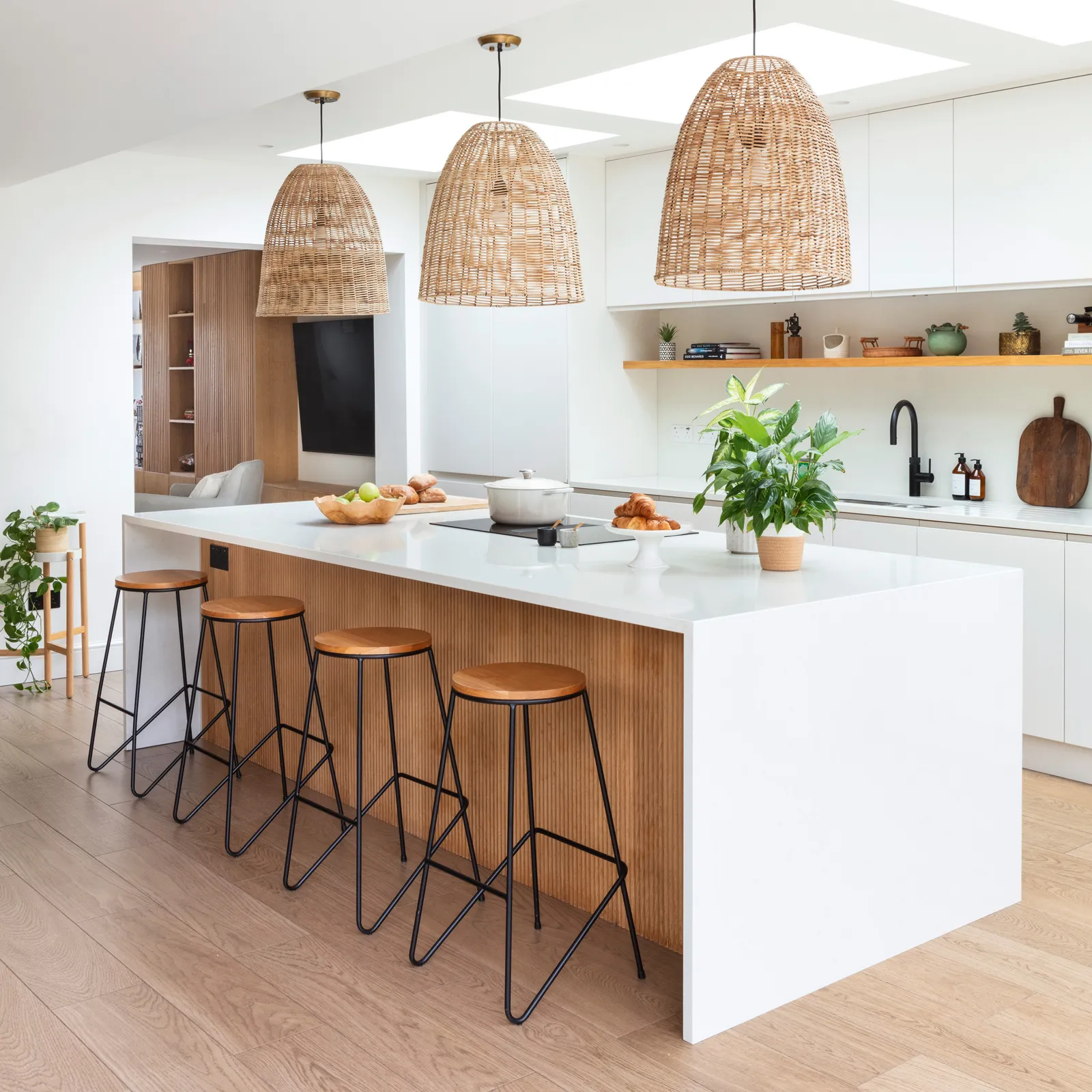
Clean-lined pendants in glass, metal, ceramic, or slim bar lights, in a row or cluster that echoes the island's length. Integrated LED profiles under wall units, in open shelves, and above tall cabinets wash stone, timber, and tile with soft light while keeping fittings almost invisible.
Colour Temperature:
3000–3500K – warm white that still feels crisp on pale stone and modern cabinetry. Every circuit on a dimmer, every layer switched separately. One space, multiple moods: sharp and bright for weekday cooking, warm and low for evenings when the kitchen reads as part of the living room.
Appliances
In a contemporary London kitchen, appliances are the engine under the bonnet – highly specified, quietly powerful, arranged in logical zones so the room swings from weekday cooking to weekend entertaining without ever feeling cluttered.
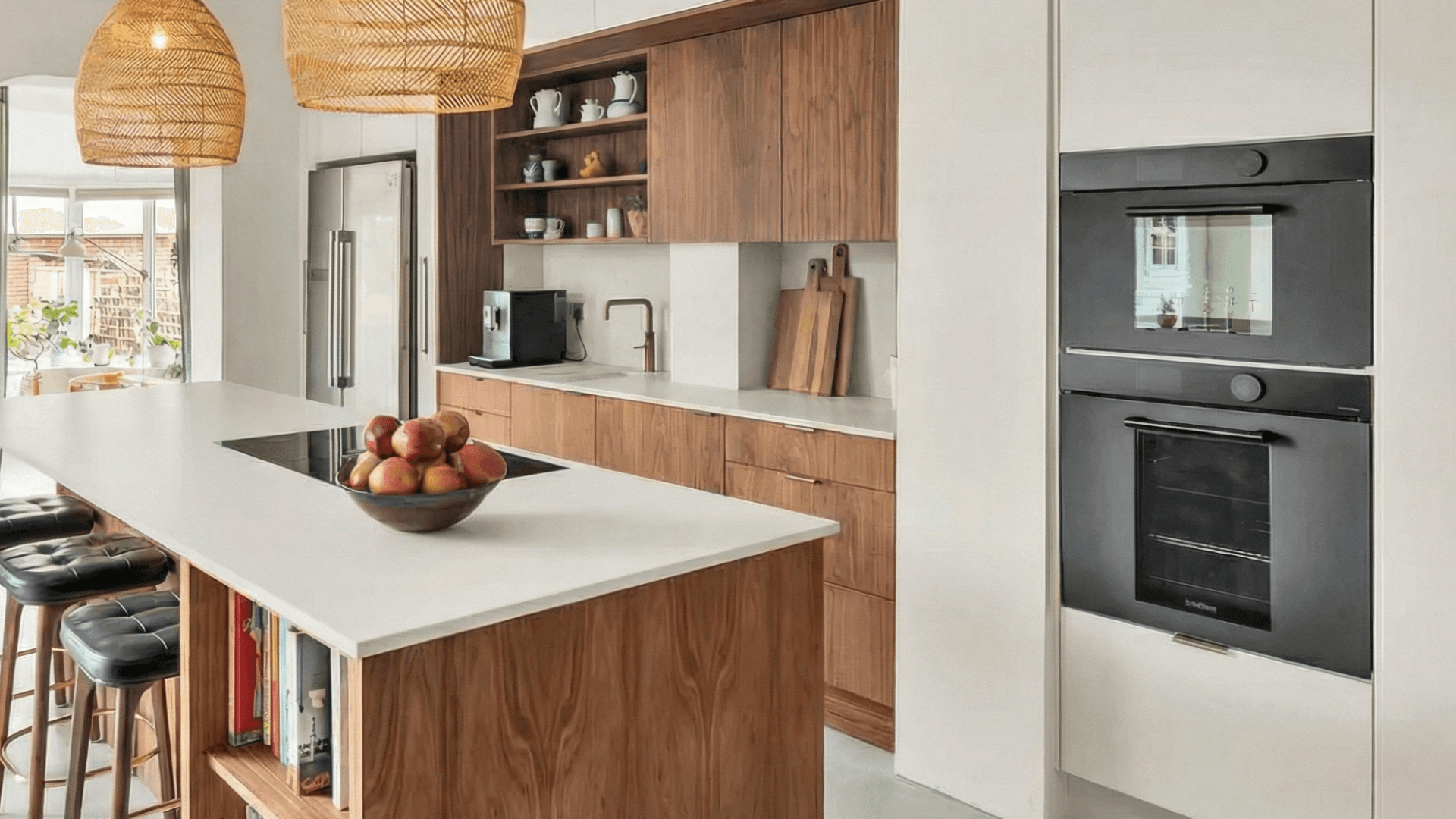
Tall banks with built-in ovens, combi or steam ovens and warming drawers are stacked in a neat grid at eye level, alongside integrated fridge-freezers and larders so the whole wall reads as one planned elevation. Hobs and sinks on islands or main runs with generous landing space on either side. Noisy or visually busy items (microwaves, small appliances) tucked into appliance garages or behind pocket doors.
Finishes For Open-Plan Rooms:
Classic stainless – still the most versatile, neutral, easy to pair with any palette
Matte finishes – softer, more considered, better fingerprint resistance
Black or black-steel – graphic, contemporary, used as accent rather than everywhere
From the hall or sofa, the appliance layout should read as architecture – a calm, tall bank with dark glass and slim stainless lines, an island with a barely-there induction top, no random white boxes in sight.
Joinery Details & Character
Contemporary joinery character comes from refinement rather than ornament – crisper frames, quieter panelling, and just enough texture to keep clean lines from feeling flat.
Slim-framed Shaker or thin-rail doors sit between traditional framed cabinetry and full slab – subtle shadow lines and profiles that read well from a sofa in an open-plan room. End panels and exposed gables treated as mini elevations (simple framing, shallow panelling, or vertical V-grooves on island backs facing the living space).
Texture Concentrated In Focal Areas:
Fluted or reeded panels on the island or selected tall units – vertical rhythm, tactile quality, pairs well with Shaker rails
Reeded or fluted glass in wall cupboards and dressers – blurs the view of crockery while catching light
Pocket doors sliding back into the carcass – coffee or bar zones that vanish with one push
Shadow gaps at plinths and ceiling junctions – thin negative lines that keep joinery feeling tailored, not boxy
In Period Shells, These Details Do The Diplomatic Work:
Thin-railed doors don't fight with original mouldings.
Fluted islands add interest towards the living area.
Simple shadow gaps and framed ends make long runs of cabinetry feel like considered pieces.
Character Living In The Fine Print:
The width of a rail, the rhythm of a fluted panel, the way a slim frame throws just enough shadow to make a kitchen feel both current and comfortably at home.
Storage
Contemporary storage is the backstage of a kitchen that looks composed from the sofa – everything has a place, and much of it can simply disappear when you're done using it.
Tall larder cupboards with internal drawers, door racks, and adjustable shelves keep dry goods, small appliances, and breakfast kit in one organised column.
Where space allows, walk-in pantries concealed behind disguised doors or full-height panels – a whole extra storage room without breaking the visual calm of the kitchen. Pocket-door units for coffee stations and appliance garages: doors slide back during the morning rush, close to restore a clean uninterrupted run of joinery.
Contemporary Storage Defaults:
Deep, full-extension drawers with organisers, peg systems, and modular dividers – everything comes to you, nothing hidden at the back
Large display or dresser-style units on one wall – books, ceramics, glass turned into a design feature rather than an afterthought
Short runs of open shelving or glazed reeded dressers – styled everyday pieces without visual chaos
Islands packed on both sides – shallow cupboards, wine racks, and everyday china on the bar side; deep drawers, bins, and pull-outs on the kitchen side
In London's Open-Plan Homes & Compact Terraces…
This kind of storage lets a contemporary kitchen stay genuinely minimal without being impractical. The everyday mess is handled quietly, the packaging and appliances are out of sight, and the room still looks composed from the garden doors.
Why Kitchen Fitters London For Contemporary Kitchens
Contemporary kitchens reward precision at every stage. We deliver it from first survey to final sign-off.
Exclusive European manufacturer partnerships – direct access to premium lacquers, bold stone slabs, fluted cabinetry, and hardware unavailable through standard trade suppliers
Full end-to-end project management – one project manager coordinates every trade so the design intent survives intact into the build
Bespoke and custom work – fluted islands, statement worktops, and joinery details designed specifically for your London property
Comprehensive warranty – materials, workmanship, and installation all covered long after completion
We bring the showroom to you – stone samples, veneer sections, and hardware finishes brought to your home so every decision is made in the right light
Contemporary Kitchen London FAQs
What defines a contemporary kitchen in London?
A contemporary kitchen in London sits between traditional and modern – Shaker or framed cabinetry with slimmer profiles, bolder colour or material contrasts, and open-plan layouts that work as a social space as much as a cooking one. Contemporary kitchen design in London is less about a single aesthetic and more about a balance: enough character to feel distinctive, enough restraint to feel liveable.
What's the difference between contemporary and modern kitchen design?
Modern kitchen design tends to mean fully handleless, flat-fronted and minimal – every line as quiet as possible. Contemporary is broader and warmer: Shaker rails still appear, materials are richer, colour is braver, and the overall feel is design-led without being stark. Modern contemporary kitchen design in London blends elements of both – the clean geometry of modern with the warmth and character of contemporary – and is often what works best in London's open-plan extensions and period terraces.
Can a contemporary kitchen work in a Victorian or Edwardian London property?
Yes, and it's one of the most satisfying combinations. Slim-framed Shaker doors don't fight with original cornicing and mouldings; fluted island panels nod to period joinery; warm metals bridge old and new. The key is in the details and proportions – cabinetry that acknowledges the architecture rather than ignoring it, and a palette that works with London's period light rather than against it.
Do you supply the kitchen materials or do I source them separately?
We handle everything. Through our exclusive manufacturer partnerships, we source cabinetry, stone, hardware, tiling, and flooring based on your design brief and budget. You don't buy anything separately – design, supply & installation are managed by one team, so there's no gap between what was specified and what gets fitted.
How long does a contemporary kitchen renovation in London take?
Most contemporary kitchen projects take 3–5 weeks from demolition to completion, depending on size, complexity, and the extent of bespoke work involved. We provide a clear timeline during the planning stage.