Styles /
modern-kitchen
Modern Kitchen In London – Clean Lines, Expertly Delivered
A modern kitchen is all precision – in the gaps, the grain, the way light moves across a flush run of joinery. We design it, source it, and build it to last.
Layout & Workflow
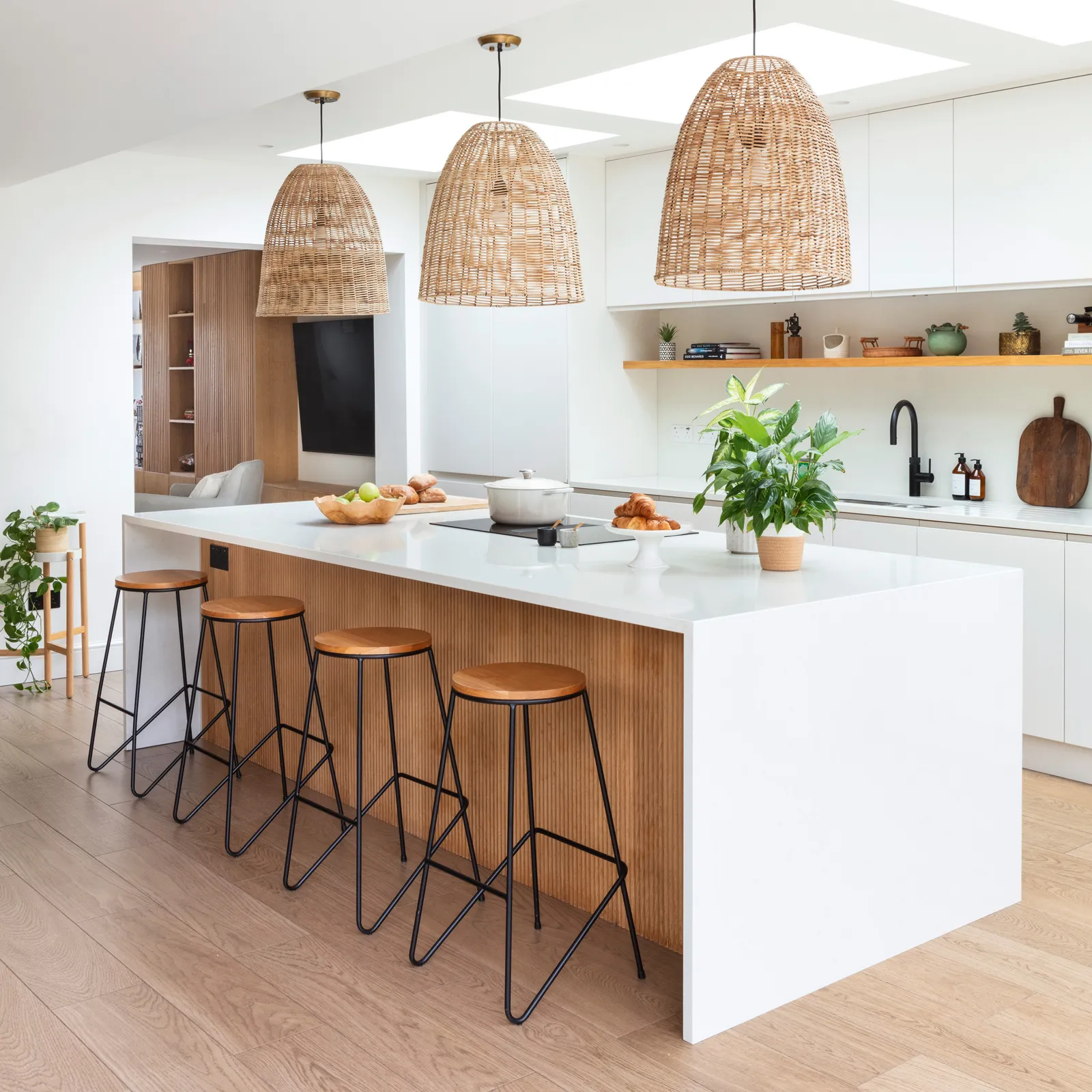
A modern kitchen in London is designed around zones, not just the classic triangle. Prep, cooking, cleaning, storage, breakfast – each set up with the tools, power and appliances it needs so nothing has to criss-cross the room unnecessarily.
The triangle still quietly underpins it all, but the real goal is a kitchen that works just as well for one focused cook as it does for a full house on a Friday night.
London Typologies We Work With:
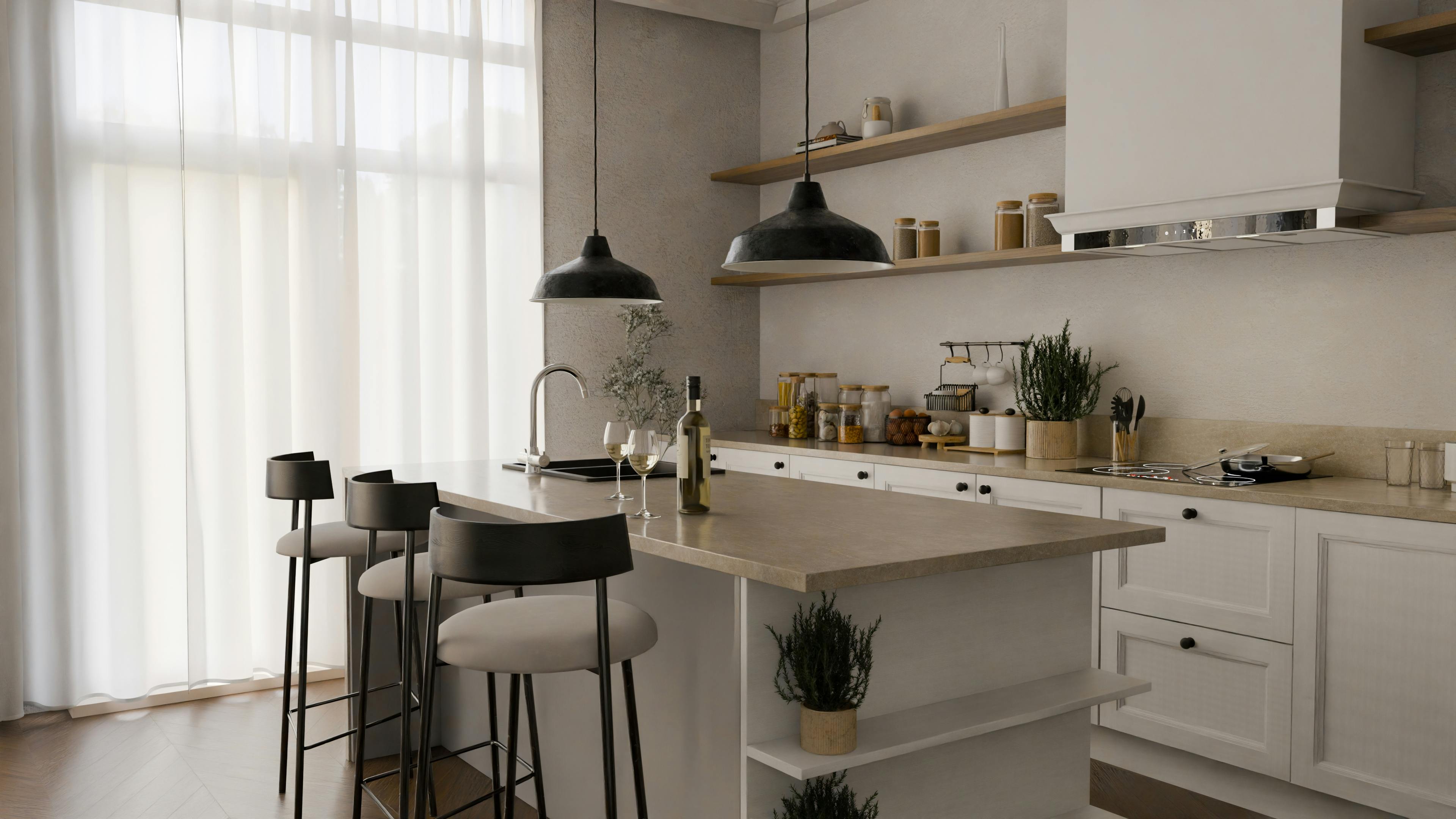
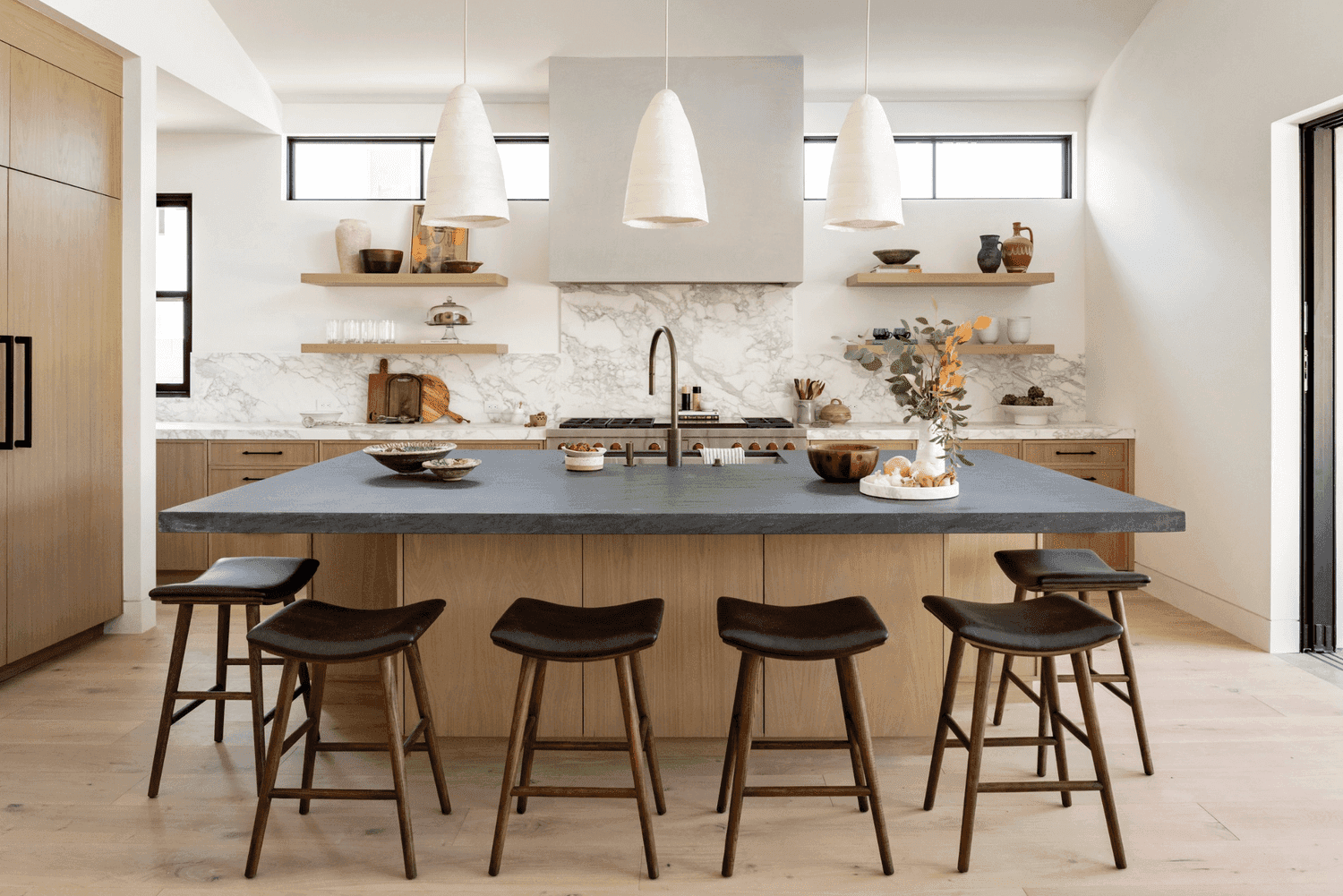
Island layouts. The command centre for larger open-plan extensions, with at least 1–1.2m clear all around for stools, doors and people to move freely.
Peninsula layouts. Many of the same benefits in tighter footprints, zoning the space without blocking views.
Long galley with island. The workhorse of side-return extensions, parallel runs pulling the action into the centre.
Single wall or compact L-shape. Borrows space from the living room in new-build flats, with a slim peninsula as the pivot point.
The hallmark of a well-planned modern layout: you never have to ask anyone to move just to open the fridge.
Cabinetry
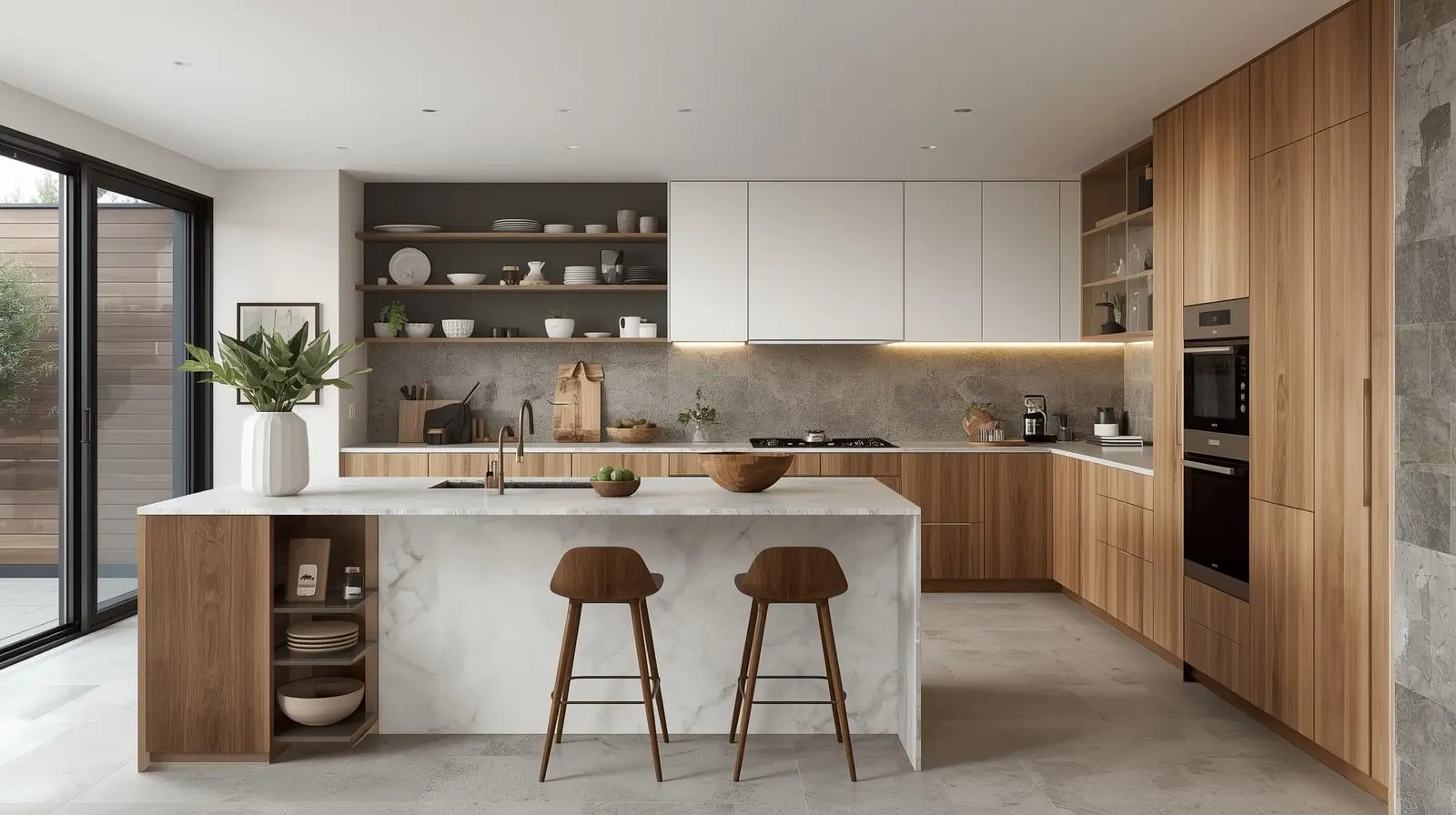
Modern cabinetry is the calm architecture of the room – long, uninterrupted lines and materials that feel sharp but liveable.
Flat slab doors in true handleless or integrated J-pull designs keep vertical lines as quiet as possible. Where a little more character is needed, transitional modern pairs slab uppers with very simple framed pan drawers, adding relief without losing the streamlined feel. The eye reads long, calm bands – wide drawer packs, tall appliance walls, minimal changes in depth so the whole room reads as one continuous plane.
Finishes Worth Considering:
Super-matt lacquers and laminates – velvety, light-absorbing, fingerprint-resistant
Rift-cut oak, walnut or ash veneer – grain and warmth in otherwise minimal rooms
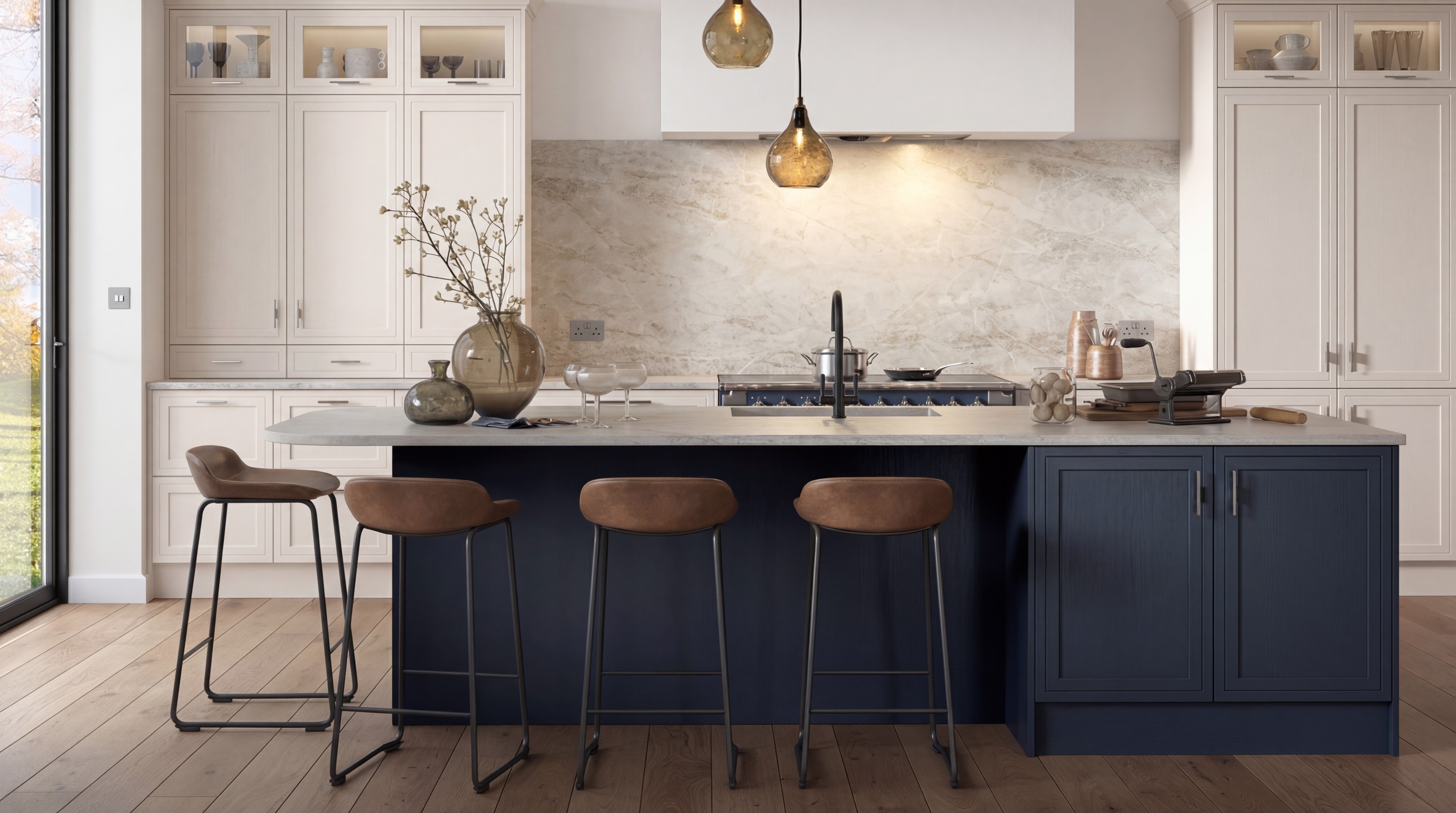
Contrast combinations – darker island anchoring paler perimeter runs, or timber bases with painted or lacquered uppers
High-gloss is now used sparingly in modern schemes – softer matt and textured finishes are considered more sophisticated and more forgiving day-to-day.
Worktops
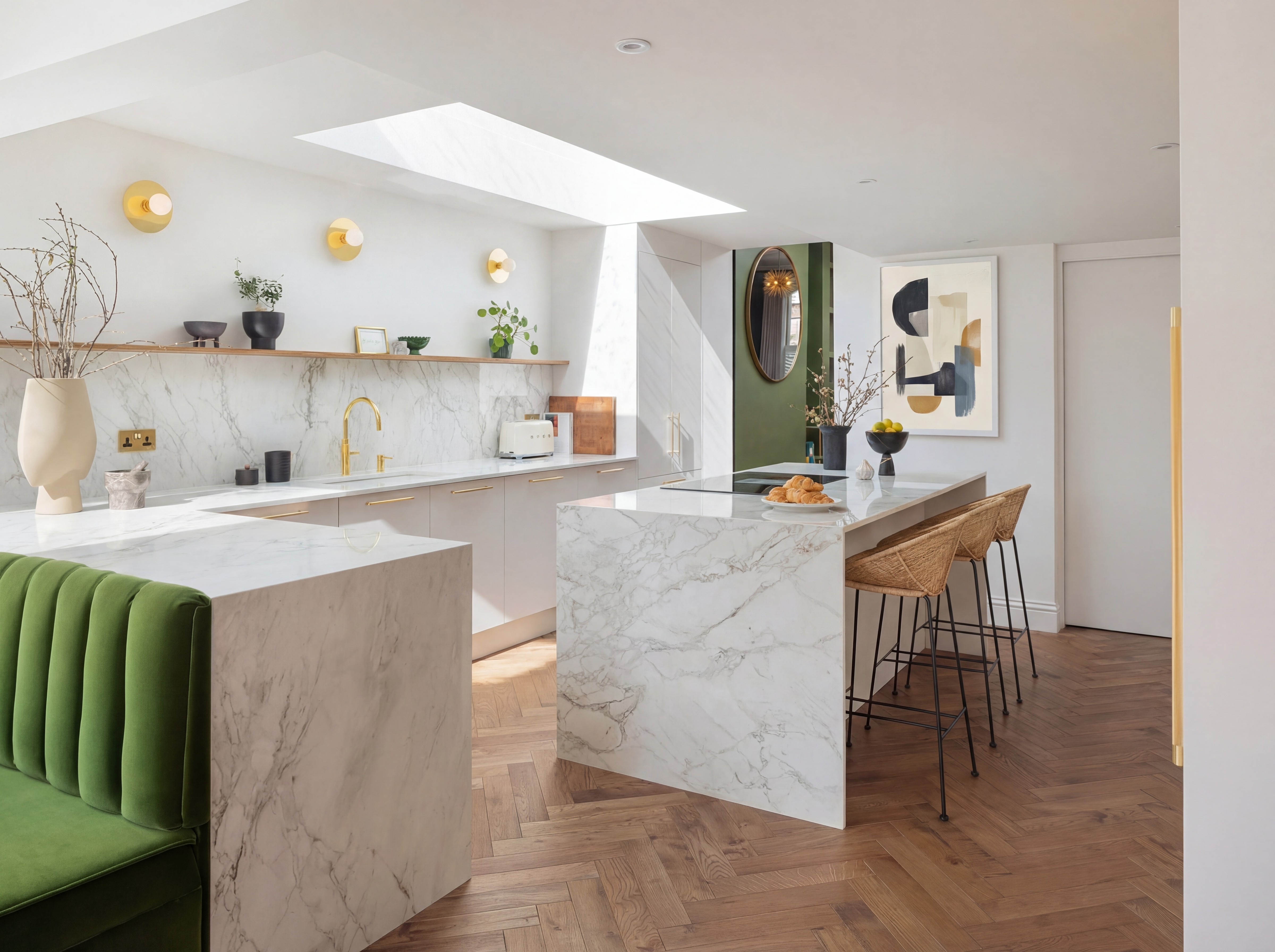
In a modern kitchen, worktops are the sleek horizontal planes that connect cabinetry, island, and splashback into one calm, contemporary composition.
Engineered quartz and sintered stone (Dekton, porcelain) dominate modern London projects – non-porous, stain and scratch resistant, and available in everything from soft concrete tones to bold marbles. Natural stone still appears in high-end schemes, but usually in honed or leathered finishes on hero elements rather than everywhere, so the patina feels intentional rather than incidental.
Profile & Proportion Matter:
Slim 12–20mm sections – light, precise, especially effective with handleless cabinetry
Mitred edges – create a chunky-looking form from a thin slab
Waterfall edges – the defining modern move, wrapping down the gable of an island for a sculptural, architectural finish
Flush-mounted hobs, undermounted sinks, recessed drainers – the surface reads as one uninterrupted plane
Hardware & Metals
In a modern kitchen, hardware either disappears entirely or adds just enough contrast to keep things interesting – never both at once.
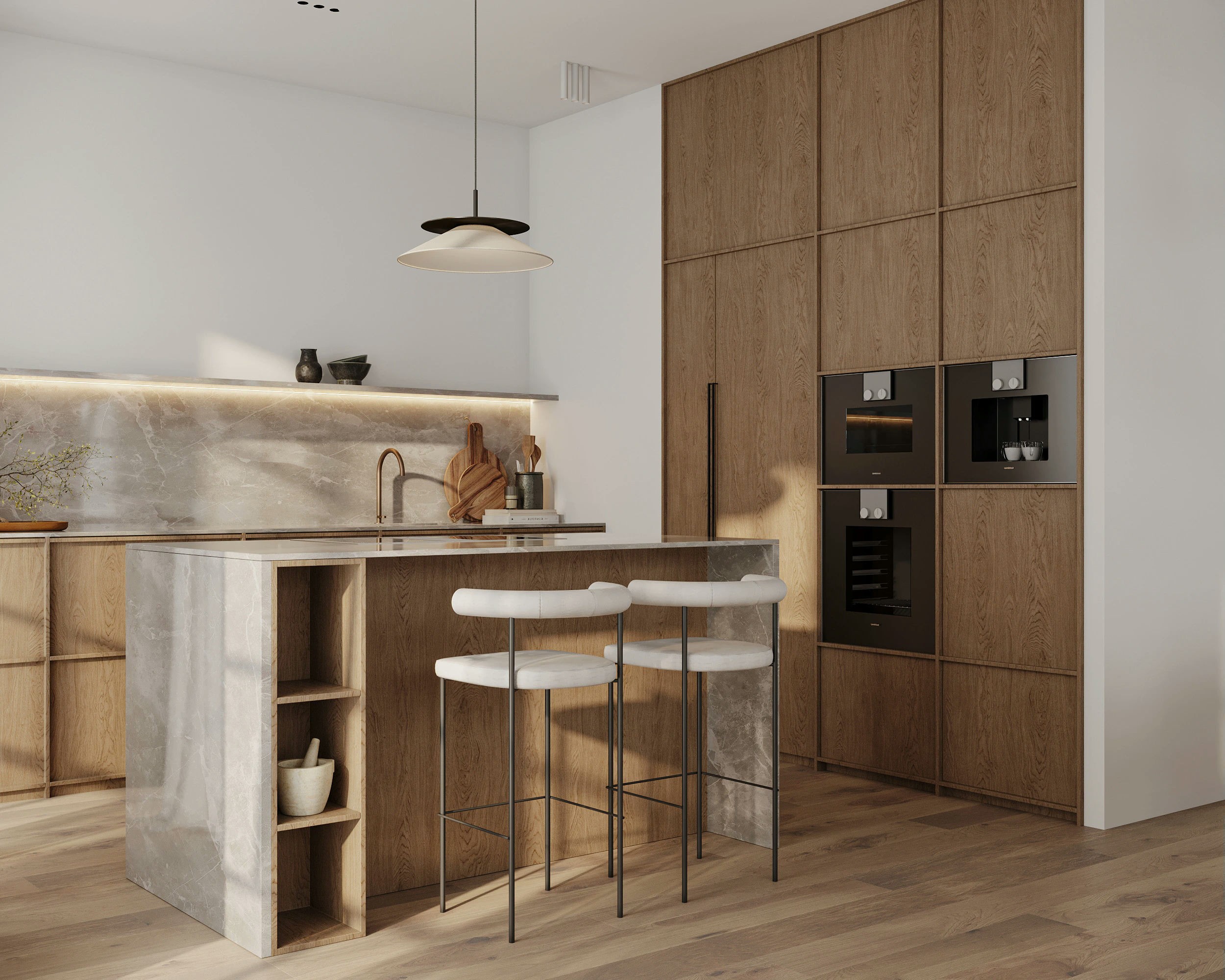
Truly handleless schemes use J-pulls, push-to-open systems, or continuous Gola rails so cabinetry reads as clean planes. Where handles are visible, they're slim bar pulls with straight, architectural profiles – black, brushed stainless or matching lacquer, aligned to reinforce the linear geometry of the room.
The Modern Metal Palette:
Matte black – grounds pale and timber schemes, now a go-to for contemporary kitchens
Brushed or satin stainless – echoes appliances and taps, crisp and technical
Warm brass or bronze accents – stops cool, minimal rooms from feeling flat
Mix Metals Intentionally
One dominant finish (around 70%), one or two accents (30%), each repeated in more than one place – handles, tap, lighting – so the rhythm feels considered rather than accidental.
Tiling & Splashback
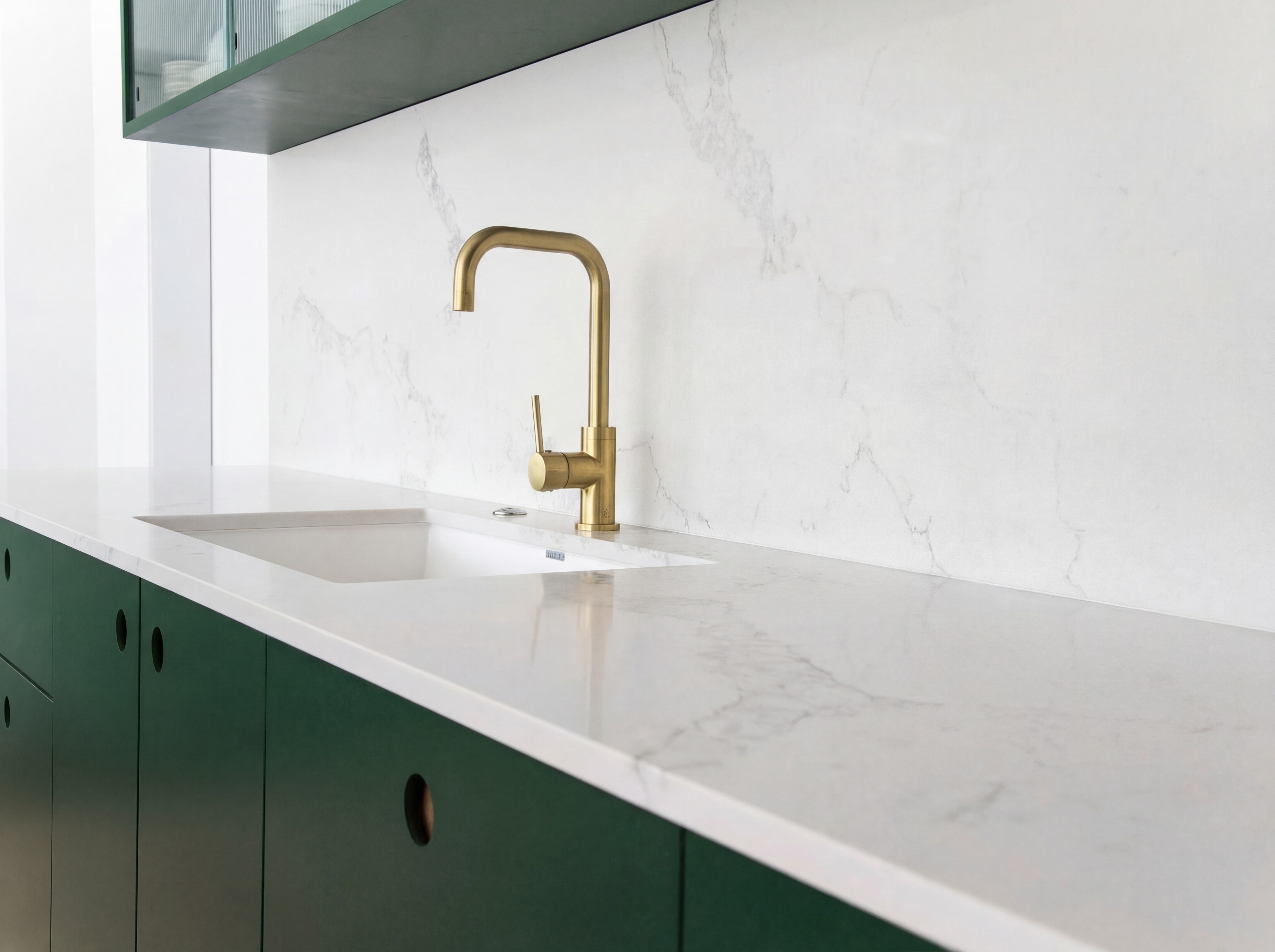
In a modern London kitchen, the splashback is less of a feature wall and more of an extension of the worktop – clean, considered and part of the same composition.
Slab stone or quartz running seamlessly up from the worktop is the most popular modern move – minimal joints, one continuous material, a tailored feel that suits handleless cabinetry.
Large-format porcelain in soft concrete, stone or neutral tones achieves a similar result with more flexibility.
Where tile is used, formats are larger, grout lines are minimal, and patterns are subtle – laid vertically to push height, or in a gentle running bond that adds texture without demanding attention.
What To Step Back From:
Small mosaics, mixed material strips, heavily patterned feature tiles across large areas – all read as dated in a modern scheme and visually fragment a space that's trying to feel calm and unified.
Flooring
The floor in a modern kitchen is the quietest surface in the room – and the one that determines whether the whole space feels coherent or not.
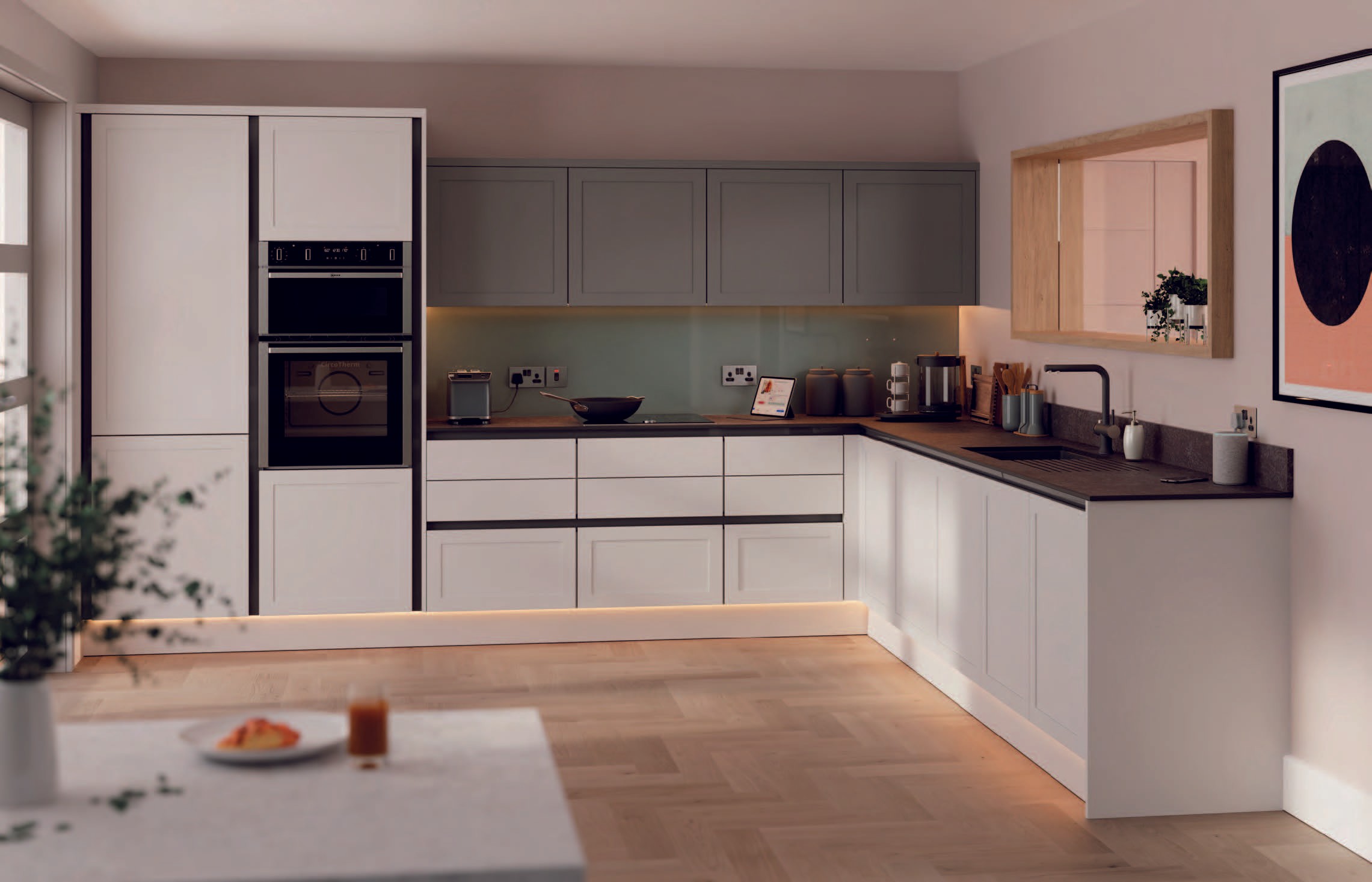
Modern schemes lean on large-format porcelain or stone-effect tiles, micro or terrazzo-look surfaces, and engineered wood or quality LVT in contemporary tones. Fewer grout lines, longer boards, calmer reads – all of which suit minimal cabinetry and open-plan living.
Herringbone and chevron – add movement and sophistication in long London terraces without feeling fussy
Terrazzo and micro-terrazzo – speckle and depth under otherwise simple kitchens, increasingly used to zone cooking and dining within one space
Smoked oak, warm concrete, putty and soft charcoal tones – hide daily dust and pet hair, work across open-plan floors running kitchen into dining and living
What Feels Out Of Date:
High-gloss tiles, flat mid-grey floors, basic plank-laid laminates – developer-standard next to considered modern joinery.
Colour Palette
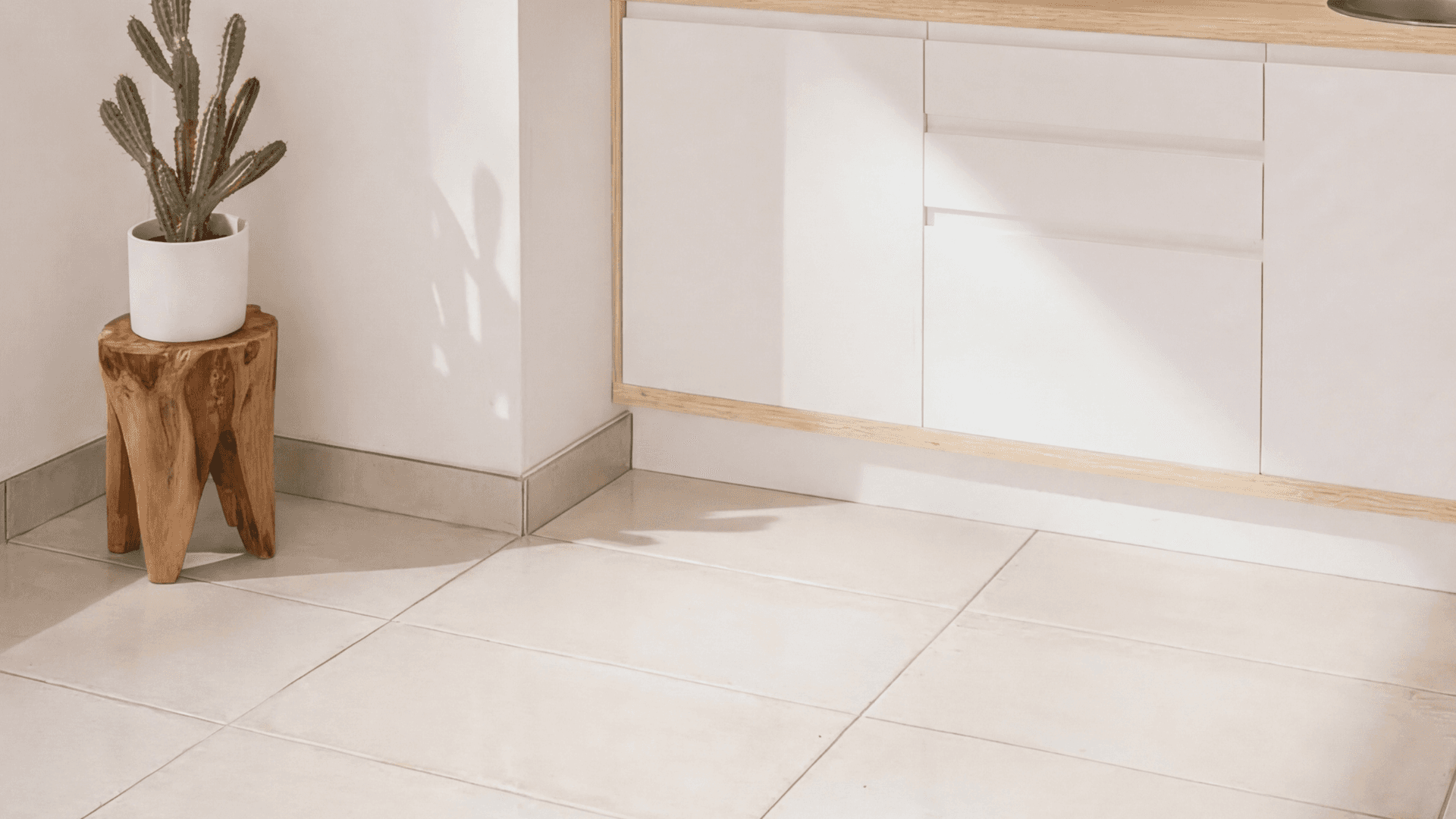
Modern schemes start with layered neutrals – warm whites, creams, stone, mushroom, putty – rather than stark white or flat cool grey. These read sophisticated, bounce limited light in deeper plans and north-facing rooms, and give you room to evolve the scheme over time without a full refit.
From there, two directions:
Controlled contrast – black or deep charcoal island under pale worktops, dark lowers with light uppers, black hardware and frames on a creamy scheme.
Muted colour as accent – sage, eucalyptus, dusty blue, inky navy on an island, a single run or the surrounding walls. Big surfaces stay neutral, colour does the character work.
Orientation Still Matters
North-facing or deep-plan kitchens favour warmer creams, greige and mushroom. South- and west-facing spaces can take cooler whites, charcoals and bolder blocks without feeling stark.
Lighting
Modern London kitchen lighting is mostly hidden, quietly layered, and designed to flex from focused weekday cooking to low, cinematic evenings.
Ambient comes from recessed downlights or linear tracks, spaced to wash cabinetry and circulation evenly – kept to a disciplined layout, in lines parallel to cabinet runs, so the ceiling feels intentional rather than peppered with holes.
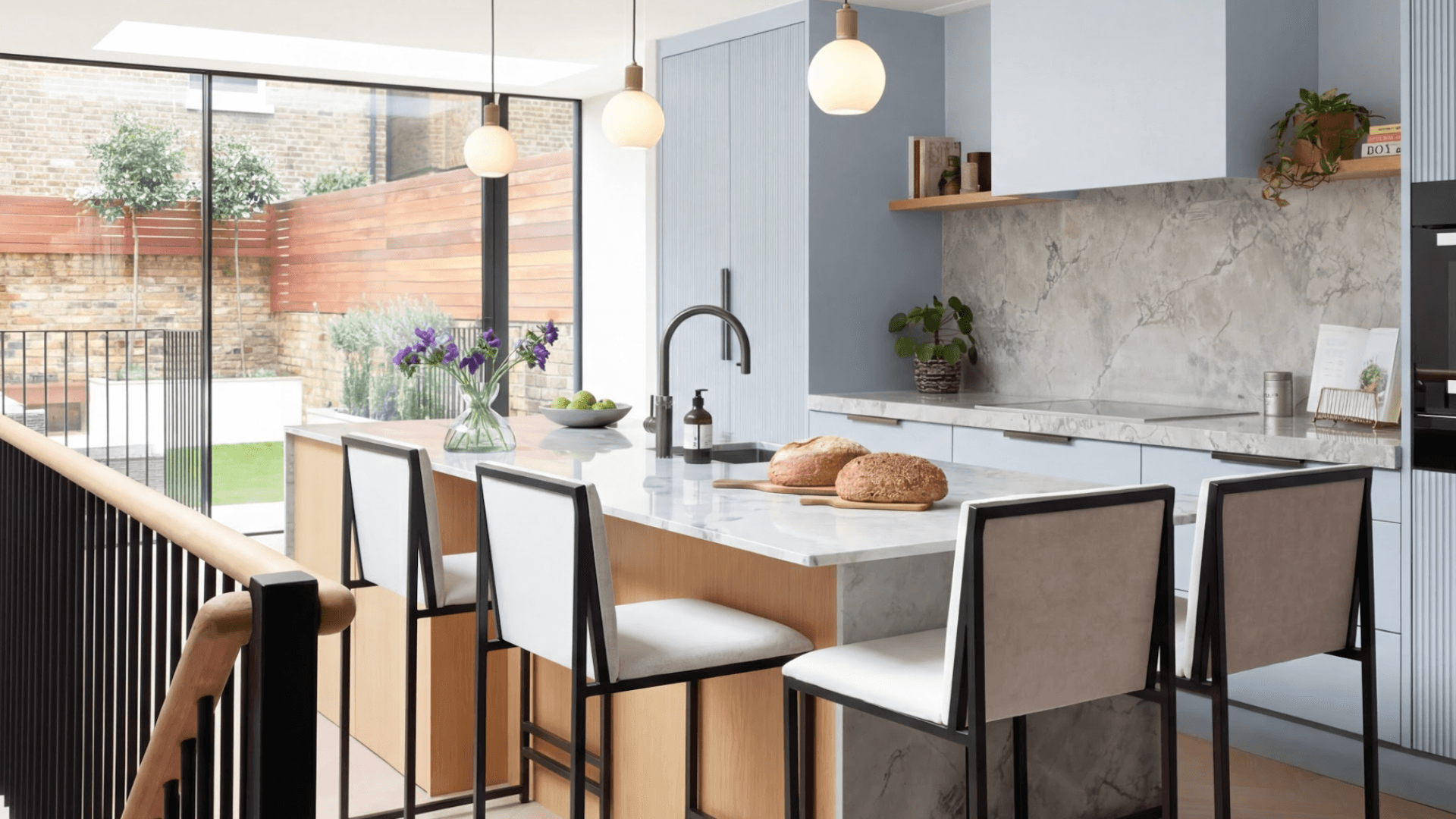
Task lighting is under-cabinet LED strips, focused spots over hob and sink, pendants over the island.
Accent is where the modern character lives: thin LED profiles in plinths, shelves and finger pulls that skim stone and timber after dark.
Over islands, slim linear bars or a tight row of simple shades sit around 75–90cm above the worktop. Ceiling tracks with adjustable heads are increasingly used in London flats – cleaner than a grid of downlights, flexible enough to aim at art, worktops or the dining table as the room evolves.
Colour Temperature
Around 3000K for general use, nudging cooler for very white minimal schemes, every circuit on a dimmer so the kitchen switches modes – bright workspace in the morning, soft living room extension by evening.
Appliances
In a modern London kitchen, appliances are the tech layer you barely notice – quiet, integrated, and aligned with the architecture rather than lined up as shiny objects.
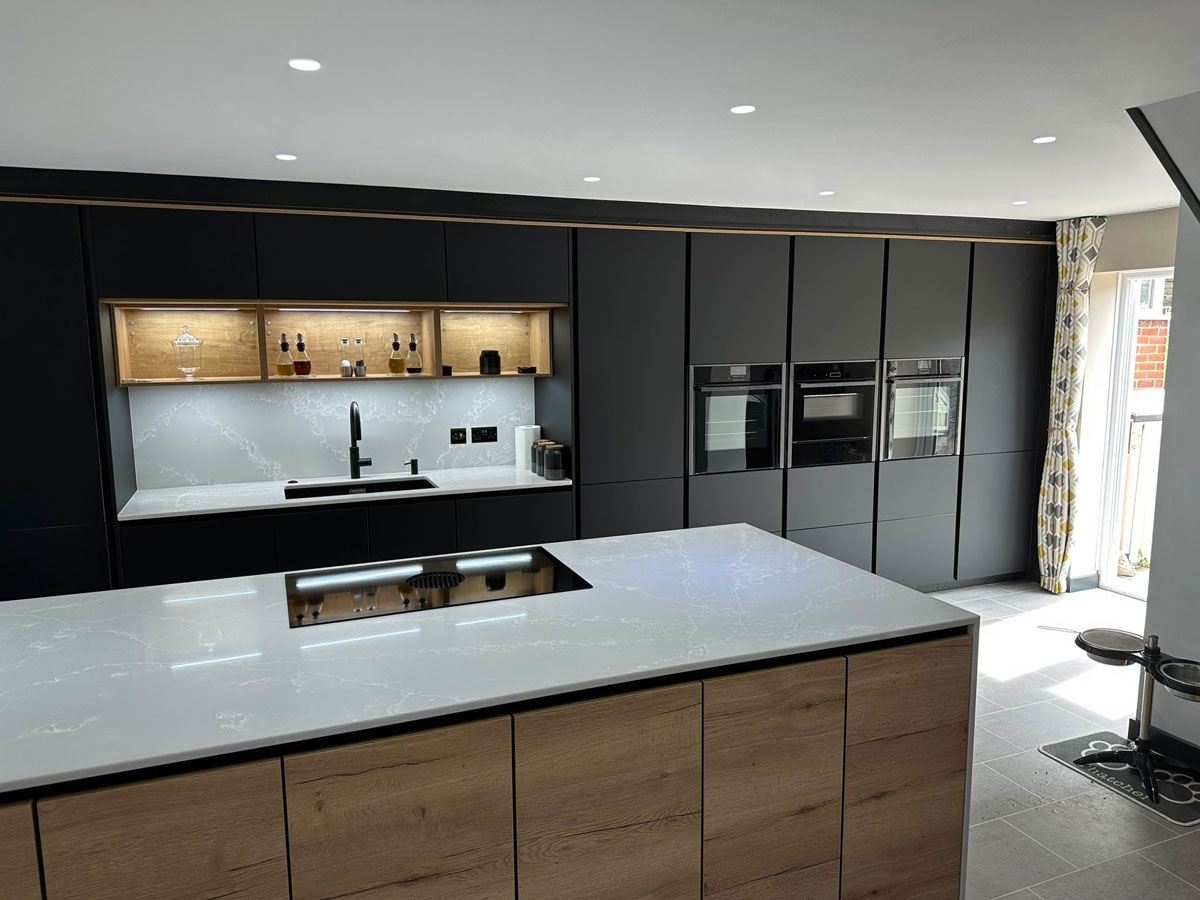
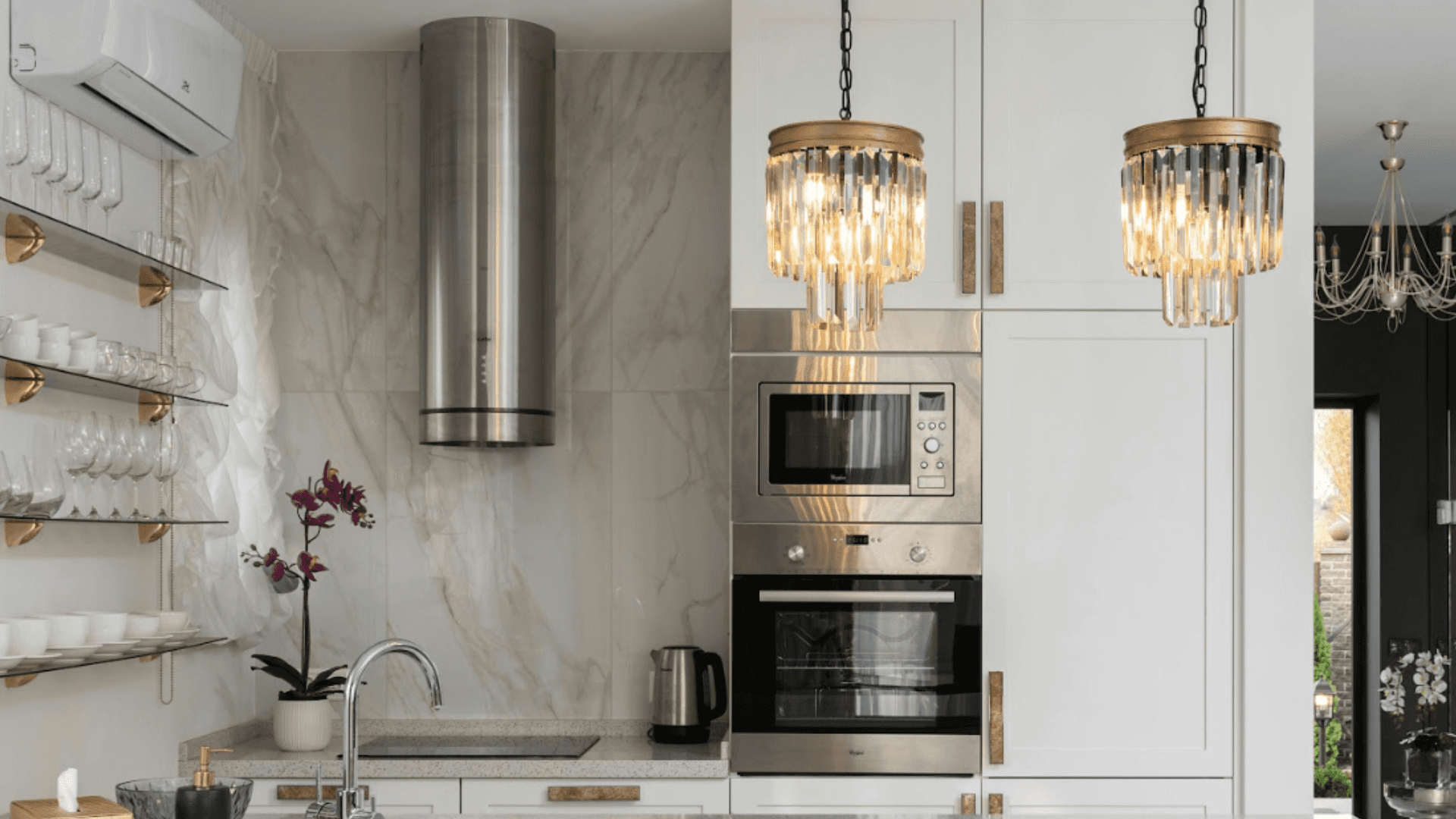
Panel-ready and fully integrated fridges, freezers and dishwashers sit flush behind cabinet doors, tight reveals, consistent depths – one continuous elevation rather than a patchwork of metal boxes.
Ovens stacked in a tall bank with warming drawers and combi or steam units.
Induction hobs on a clear run or island with generous landing space either side.
Extraction handled by quiet ceiling or downdraft systems to keep sightlines open and noise low into the living area.
Finishes:
Stainless steel remains the most adaptable exposed choice – neutral and easy to pair with almost any palette. Matte and black steel offer a softer or more dramatic read with better fingerprint resistance.
Joinery Details & Character
Modern joinery is about precision and restraint. Character lives in the gaps, the grain and the way light catches an edge – not in heavy mouldings or decorative profiles.
Slim, consistent shadow gaps at ceiling, floor and between tall runs give cabinetry a floating, framed effect. Tight, even door gaps and continuous plinth lines matter as much as the doors themselves – the discipline of the gaps is what makes a modern kitchen feel tailored rather than fitted off the shelf.
Where Texture Enters:
Fluted and ribbed fronts on islands or tall units – vertical rhythm, depth, light-catching without visual noise
Timber shadow-gap cladding and hot-rolled metal panels – gallery-like surfaces that wrap islands or feature walls
Pocket doors sliding back to reveal coffee or bar zones – the satisfaction of a door disappearing into a notch
Beautifully lined larders and concealed charging drawers – crafted, tech-aware storage behind flush fronts
In London properties, these details stop a modern kitchen from feeling generic. Shadow gaps negotiate wonky ceilings. Fluted timber on an island nods to original floorboards. A hot-rolled metal run underlines industrial steel windows. Minimal but never blank.
Storage
Modern storage keeps surfaces clear and sightlines clean, especially in open-plan spaces – and still makes every move feel obvious.
Tall, handleless banks hide larders, utilities, and breakfast bars behind flush facades.
Full-height cabinet larders with internal drawers, door racks, and integrated lighting keep dry goods, small appliances and glassware organised and invisible.
Pocket-door units (doors sliding back into the carcass) are used for coffee stations, bar cupboards and prep zones so the busy side of kitchen life can vanish completely when needed.
Modern Storage Defaults:
Deep, full-extension drawers for pans, plates and appliances – contents come to you, nothing at the back of a cupboard
Narrow pull-outs beside the hob for oils and spices
Integrated bin and recycling drawers and concealed charging ports in the island
One curated run of open shelves or a glazed tall unit – enough display to add personality, not enough to feel cluttered
In London's tight terraces and apartments, these moves are what make a modern kitchen liveable. Full-height handleless runs swallow everything from buggies to overflow pantry. Slim pull-outs make awkward nooks work. Pocket-door zones mean a family kitchen can read as composed and minimal by supper, even when life around it has been anything but.
Why Kitchen Fitters London For Modern Kitchens
Precision design is only worth something if the execution matches. Ours does.
Exclusive manufacturer partnerships – direct access to premium lacquers, veneers, sintered stone and hardware unavailable through standard trade suppliers
Full end-to-end project management – one project manager coordinates every trade from survey through to final sign-off, so the precision of the design survives into the build
Bespoke and custom work – shadow gaps, fluted panels, pocket-door zones designed specifically for your London property
Comprehensive warranty – materials, workmanship and installation all covered long after completion
We bring the showroom to you – veneer samples, worktop sections and hardware finishes brought to your home so every decision is made in the right light
Modern Kitchen London FAQs
What defines modern kitchen design in London?
A modern kitchen in London is built around clean lines, handleless or minimal cabinetry, integrated appliances, and open-plan layouts that connect kitchen to living space. Modern kitchen design in London is less about a single aesthetic and more about a discipline: every element is considered, nothing is decorative for its own sake, and the result feels calm and precise.
What's the difference between a modern and a contemporary kitchen?
Modern kitchen design tends to mean clean, minimal, handleless – a restrained palette, integrated appliances, flat fronts. Contemporary is broader and bolder: statement islands, dramatic materials, more expressive use of colour and texture. Both sit under the umbrella of current design thinking, but modern leans quieter and more architectural while contemporary leans more design-led and individual.
Can a modern kitchen work in a period London property?
Yes, and it often works beautifully. The contrast between original features (cornicing, sash windows, original floors) and clean, minimal joinery creates a layered, interesting tension that feels genuinely London. The key is in the details: shadow gaps that negotiate imperfect ceilings, materials that nod to the building's character, and a palette that bridges old and new rather than ignoring the architecture entirely.
What does a modern luxury kitchen London project typically involve?
A modern luxury kitchen London project with us starts with a free survey and design consultation, moves through material selection (with samples brought to your home), and covers full supply and installation – cabinetry, worktops, tiling, flooring, appliances and all associated trades. One project manager coordinates everything.
Do you handle the full renovation or just the kitchen fitting?
We handle everything. Design, supply, all trades (electricians, plumbers, tilers, worktop specialists, cabinet fitters) coordinated by one project manager from survey through to handover. That end-to-end management is where we add the most value, particularly on modern projects where precision and sequencing matter enormously to the final result.